March 27, 2026
Why Are There So Many AI Writing Tools Right Now? The Data Has an Uncomfortable Answer
AI writing tools make up 36% of all new SaaS launches we track — but their monetization rate is just 12.4%, far below Finance (21.4%) or Education (27.9%). Here's what the numbers reveal.
The AI writing tools market in 2026 feels impossibly crowded. Open any indie hacker forum and you'll find three new "AI content assistants" launched this week alone. Our platform tracks 23,744 active SaaS sites — and AI Tools plus Writing & Content together account for 8,531 of them, a full 36% of everything we monitor.
So why does it feel like nobody is actually making money?
The short answer: they aren't. Not at the rate you'd expect from the category's sheer size.
The Numbers Don't Lie: Big Category, Weak Conversion
Across our dataset of 23,744 effective sites (data as of 2026-03-27), the overall monetization rate sits at 17.3% — meaning roughly one in six new SaaS products shows active payment infrastructure.
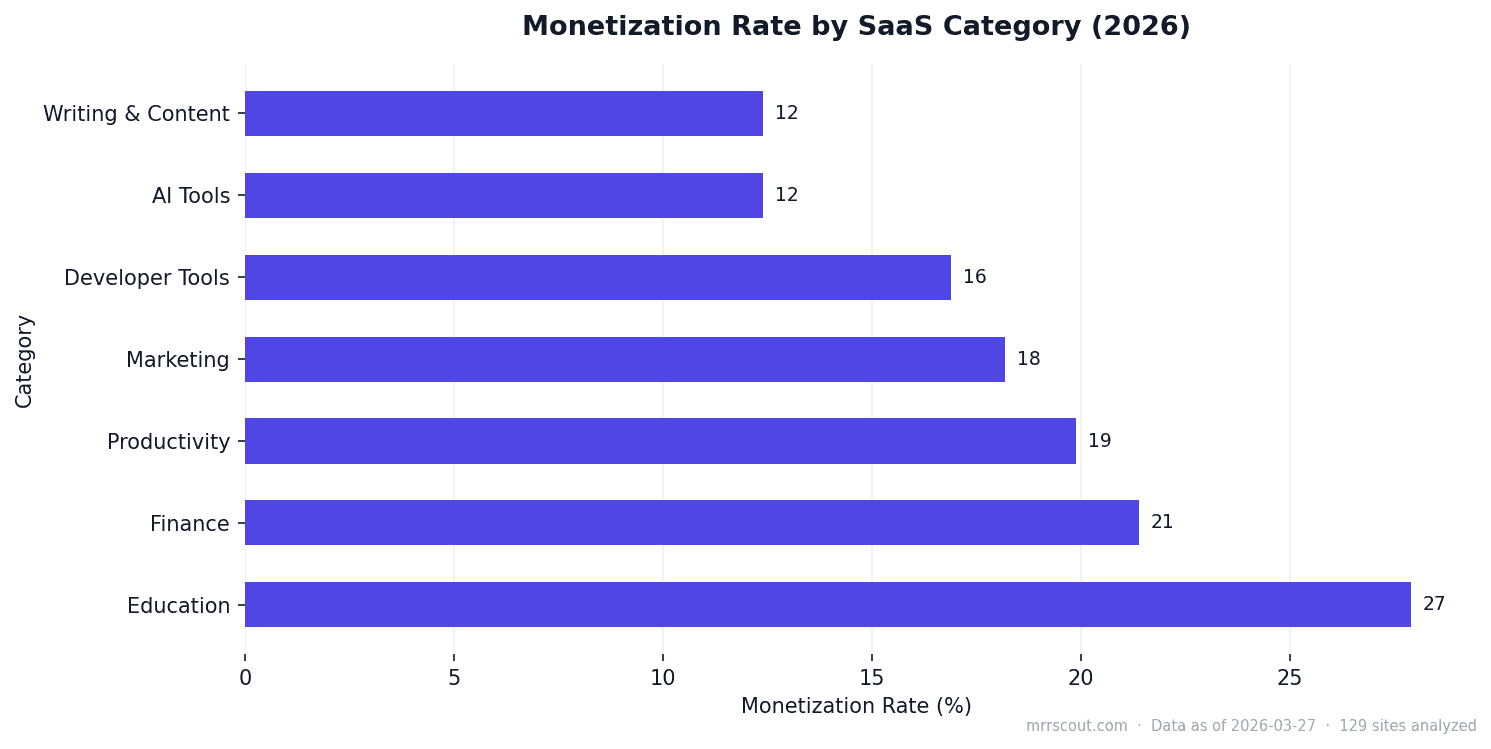
AI Tools and Writing & Content both clock in at 12.4%. That's not terrible in isolation. But compare it to the rest of the landscape:
| Category | Sites Tracked | Monetization Rate |
|---|---|---|
| Education | 262 | 27.9% |
| Finance | 565 | 21.4% |
| Productivity | 664 | 19.9% |
| Marketing | 791 | 18.2% |
| Developer Tools | 2,251 | 16.9% |
| Writing & Content | 715 | 12.4% |
| AI Tools | 7,816 | 12.4% |
Education converts at more than twice the rate of AI writing tools. Finance is nearly double. Even Developer Tools — another crowded space — pulls ahead by 4 percentage points.
The market producing the most products is producing some of the worst conversion numbers.
Why So Many AI Writing Tools Exist (It's Not Because They Work)
We expected the answer to be "low barrier to entry." And that's partly true. But the data reveals something more specific.
Of the 8,531 AI Tools and Writing & Content sites in our dataset, 3,515 had their domain registered within the last 90 days. That's 41% of the entire category — nearly half — launched in a three-month window. No other category we track shows this kind of registration velocity.
The pattern is clear: LLM APIs dropped the cost of building an AI writing product to near-zero. Someone can spin up a "paraphrase your emails" tool over a weekend using a $20 API key. What they can't do is find a customer willing to pay for it.
Sites like stealthwriter.ai (AI detection bypass) and mdedit.ai (AI-assisted markdown editor) both launched with pricing pages and genuine use cases. They represent the top of the funnel — the products that actually thought about monetization. But for every one of those, our platform surfaces dozens of near-identical tools with no clear differentiation and no paying users.
The Saturation Signal Nobody Talks About
Here's the uncomfortable part: the newest tools aren't catching up.
AI writing products registered in the last 90 days have a monetization rate of 13.5%. Products 3+ years old in the same categories? 14.5%. The gap is almost nothing — but it's moving in the wrong direction.
In most healthy markets, newer products in a growing category outperform older ones. The incumbents get disrupted, fresh approaches find underserved niches, and conversion rates climb as the market matures. That's not happening here. The wave of new AI writing launches is adding volume without adding quality.
What we found instead: the products that do monetize aren't winning because they're "AI-powered." They're winning because they solve a specific workflow problem — and the AI is incidental.
The Comparison That Should Make You Think Twice
Across all categories we track, Education SaaS monetizes at 27.9% — more than double the AI writing rate. Finance tools hit 21.4%. These are harder categories to build in, with more complex compliance requirements and higher customer acquisition costs.
And yet they convert better. A lot better.
Our read: when a product solves a problem with real financial or educational stakes, customers accept paying for it. An AI writing tool that promises to "improve your content" competes against free alternatives — ChatGPT, Claude, a dozen browser extensions. The value proposition is blurry. The switching cost is zero.
The categories with the highest monetization rates share one trait: the pain they solve is concrete and the alternative (doing nothing) is clearly worse.
What Survives the Shakeout
Not all 8,531 AI writing and tools sites are equal. Among the ones that do monetize, a few patterns stand out:
Specificity wins. Tools built for one workflow — cuckoo.sh for structured writing, redact.dev for document redaction — have higher pricing page presence than generic "AI writing assistants." A narrow use case is easier to charge for.
Pricing page presence is a leading indicator. Of the monetized AI tools and writing sites in our dataset, 54% have a visible pricing page. Among the non-monetized ones, only 4.5% do. The willingness to show a price is itself a signal of product seriousness.
The 90-day window matters. Among AI writing tools that launch with a pricing page from day one, monetization rates are measurably higher than those that add it later. Builders who plan to charge tend to build something worth charging for.
So Why Are There So Many?
Because building one takes a weekend and costs almost nothing. Because "AI writing tool" sounds like a fundable idea in 2026. Because the founders launching them aren't wrong that content is a pain point — they're just wrong that their specific tool solves it better than what already exists.
The market is doing what markets do: running a fast, brutal experiment at scale. Most of these tools will be gone in 18 months. The 12.4% that are already charging — and the fraction of those that have found real retention — are the ones worth watching.
Frequently Asked Questions
Why are there so many AI writing tools being launched right now?
The cost to build an AI writing tool dropped dramatically with accessible LLM APIs. A functional product can be launched in a weekend for under $100 in infrastructure. Low barriers to entry created a volume surge — but low barriers also mean most entrants haven't validated that anyone will pay.
Are AI writing tools profitable?
Some are. In our dataset of 8,531 AI Tools and Writing & Content sites, 12.4% show active payment infrastructure. That's roughly 1 in 8. The profitable ones tend to be narrowly focused on a specific workflow rather than general-purpose writing assistants.
Is the AI writing tool market saturated?
By volume, yes — AI Tools is the single largest category we track, accounting for 33% of all monitored SaaS sites. By monetization, the market is still sorting itself out. Products with clear pricing and specific use cases continue to find customers; generic tools are struggling.
How does AI writing tool monetization compare to other SaaS categories?
Poorly, by the numbers. AI writing tools monetize at 12.4%, compared to Finance (21.4%), Productivity (19.9%), and Education (27.9%). The categories with the highest monetization rates tend to solve problems with concrete financial or workflow stakes.
What separates AI writing tools that monetize from those that don't?
Three signals stand out in our data: a visible pricing page from day one, a narrow and specific use case (rather than "AI for all your writing needs"), and a problem with a clear cost of inaction. Generic tools competing against free alternatives rarely find paying users.
How many new AI writing tools are being launched?
Our platform detected 3,515 new AI Tools and Writing & Content sites with domain registrations in the last 90 days alone — 41% of the entire category registered within a three-month window. The launch rate is high; the survival rate is not.
Where does MRRScout's data come from?
All statistics in our articles come from MRRScout's intelligence platform, which continuously monitors 24,000+ newly launched websites across Reddit, Product Hunt, Hacker News, BetaList, certificate transparency logs, and domain activity feeds. Sites are classified as monetized only when active payment infrastructure is detected — not based on self-reported MRR or founder claims. Data snapshots are timestamped in each article. Full database: [mrrscout.com/discover](https://mrrscout.com/discover).
Want to discover rising micro-SaaS before the crowd does?
Join the MRRScout waitlist