March 9, 2026
The Two Signals That Separate Serious SaaS From Noise in 2026 (Data From 24,000 Sites)
We analyzed 24,000+ new websites and found two public signals that predict monetization with 84.6% accuracy. Here's what they are and why they work.
Most new websites are noise. Out of the 24,000+ sites we track, only about 4% show any sign of real monetization. The question is: can you identify the serious ones before the crowd does?
After analyzing our full dataset, we found two public signals that — when present together — predict monetization with striking accuracy. No insider access required. Both are visible to anyone who knows where to look.
The Data: Signal Combinations vs. Monetization Rate
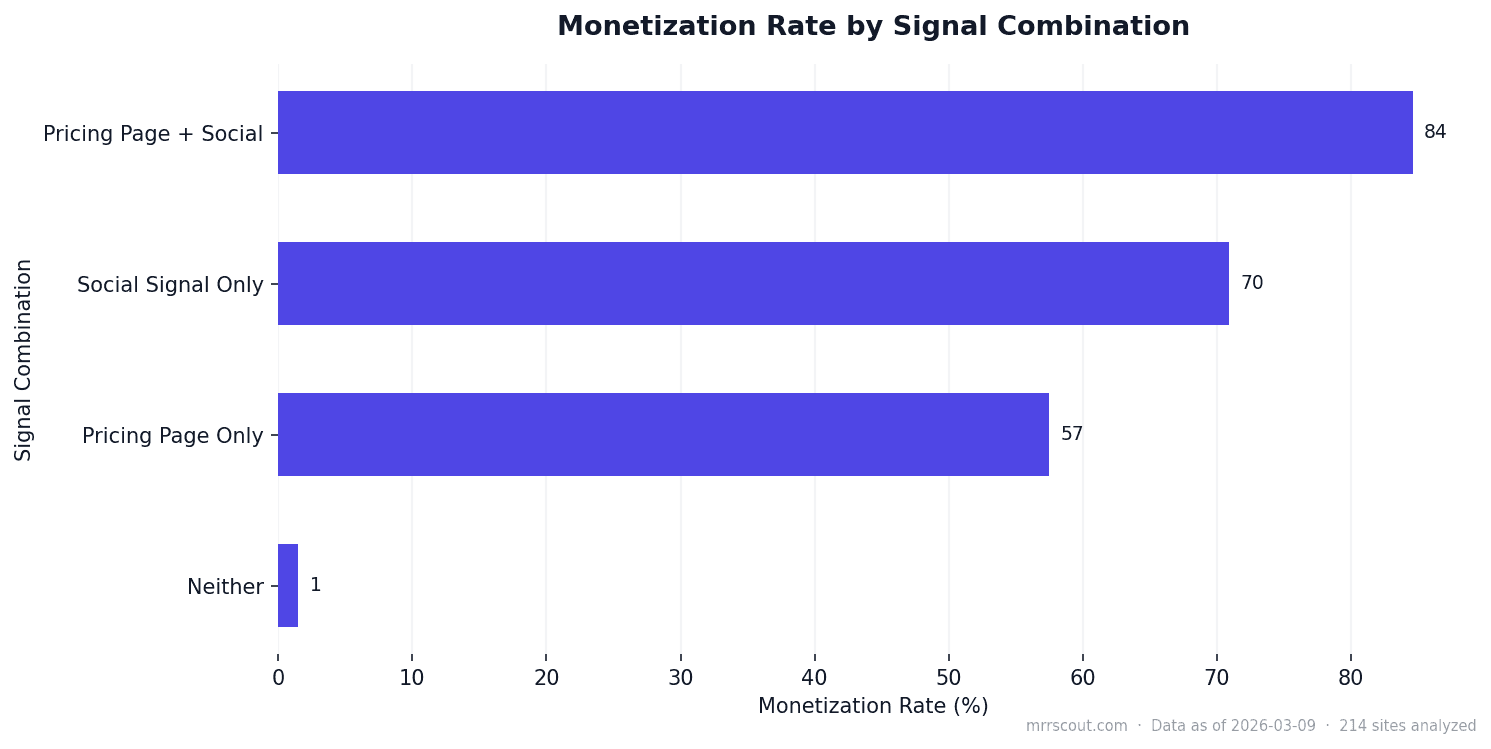
The gap is not subtle. In our dataset of 24,483 sites, here is how each combination plays out:
- Pricing Page + Social Signal: 84.6% monetization rate (240 sites)
- Social Signal Only: 70.9% monetization rate (203 sites)
- Pricing Page Only: 57.5% monetization rate (579 sites)
- Neither: 1.5% monetization rate (25,461 sites)
The difference between "both signals present" and "neither" is a 56× gap. Data as of 2026-03-09, 24,483 sites tracked.
Signal 1: A Pricing Page
A pricing page means the founder has done three hard things: defined their offer, picked a price, and committed it publicly. That commitment separates products with paying customers in mind from those that are still "maybe someday" projects.
In our dataset of over 24,000 sites, only 819 have a pricing page — that's 3.3%. But among those 819, over half are already monetized. A pricing page is not just a UI element. It is a declaration of intent.
Signal 2: A Social Signal
A social signal means someone has talked about the product publicly — on Reddit, Product Hunt, Hacker News, or a similar platform. This is harder to fake than a pricing page. It requires either the founder actively promoting their work or, better, a third party finding it interesting enough to share.
What surprised us: social signal alone (without a pricing page) predicts monetization at 70.9% — higher than a pricing page alone at 57.5%. Buzz without a price tag still outperforms a price tag without buzz.
Why the Combination Is So Powerful
We expected the pricing page to be the dominant signal. It is not. Social traction edges it out on its own.
But together, they form a feedback loop that is hard to fake: the founder has thought clearly enough about their product to price it, and the market has responded with enough interest to generate public discussion. That combination filters out almost everything except real businesses.
Real examples from our database that match this profile:
- okkslides.com — AI presentation tool with a clear pricing page and community discussion
- truepalette.io — color palette tool that went from launch to social traction to paid users
- sellshots.co — AI product photography for e-commerce, pricing visible, actively discussed on Reddit
Each of these was discoverable through public signals before they appeared on any curated list.
The 1.5% Problem
The vast majority of sites — over 25,000 in our index — have neither signal. These are the graveyard of side projects: domains registered, a landing page thrown up, and then nothing. No pricing, no social traction, no monetization.
This is worth acknowledging as a data limitation too: our platform detects monetization through visible signals like payment integrations and pricing pages. Some products monetize through private channels we cannot see. The real monetization rate for the "neither" group may be slightly higher than 1.5%, but not materially so.
How to Use This as a Founder
If you are building right now, these two signals are your minimum viable validation checklist:
- Ship a pricing page early. Not after the product is "ready." Before. It forces clarity and signals seriousness to anyone who lands on your site.
- Get one piece of social traction. A Reddit thread, a Hacker News Show HN, a Product Hunt launch — anything that puts your product in front of a public audience and invites response.
Neither requires a large audience. Neither requires funding. Both are within reach on week one.
How to Find Products That Already Have Both Signals
Knowing the signals is one thing. Finding products that match them — before they are widely known — is the actual edge.
The naive approach is to scroll Product Hunt every day. But our data shows Product Hunt has a monetization rate of only 48.7% among the products we track from that source. You are seeing a curated, highly visible slice of the market. The most interesting products are often not there yet.
Here is how we approach discovery at MRRScout:
1. Monitor communities where founders announce early. Reddit (r/SideProject, r/entrepreneur, r/indiehackers) and TAAFT (There's An AI For That) both show monetization rates above 77% in our dataset — far higher than Product Hunt's 48.7%. Products that show up here are often days or weeks old, and their founders are actively engaging with feedback.
2. Check for a pricing page immediately. When you find an interesting product, the first thing to check is whether it has a /pricing page. If it does, the founder is serious. If it does not, bookmark it and check back in 30 days.
3. Look for cross-platform traction. A product that appears on both Reddit and Product Hunt — or Reddit and Hacker News — within the same week is showing compounding social signal. That overlap is rare and worth paying close attention to.
4. Track the gap between domain registration and first social appearance. Products that generate buzz within 30 days of domain registration are moving fast. In our dataset, 35% of monetized products showed their first payment signal within the first month. Speed matters.
What we built MRRScout to do is automate exactly this process — continuously scanning new websites across sources, checking for pricing pages and payment integrations, and scoring products by their signal strength. Instead of spending hours manually checking communities, you get a filtered view of the products that already match the profile.
The signal combination we described above — pricing page plus social traction — is essentially the filter we apply. Everything else is noise.
About Our Data
All findings in this article are derived from MRRScout's intelligence platform, which continuously monitors newly registered and launched websites across multiple discovery channels — including certificate transparency logs, product launch communities (Reddit, Product Hunt, Hacker News, BetaList, TAAFT), and domain activity feeds.
Our platform visits each discovered domain and checks for: pricing page presence, payment gateway integrations (Stripe, Paddle, Shopify, Lemon Squeezy, and others), social signal activity, tech stack fingerprints, and domain registration date. A site is classified as "monetized" only when active payment infrastructure is detected — not based on self-reported MRR or founder claims.
The dataset referenced in this article covers 24,483 websites as of 2026-03-09. This is a living dataset — sites are added continuously and re-checked periodically. All percentages and counts reflect a point-in-time snapshot.
MRRScout does not sell or share raw domain data. The full filtered database is browsable at mrrscout.com/discover.
Frequently Asked Questions
What counts as a "social signal" in your data?
We track public posts and discussions about a domain across platforms including Reddit, Product Hunt, Hacker News, and BetaList. A post by the founder counts, as does an organic mention by someone else.
Does the order matter — pricing page first or social signal first?
Our data does not track order, only co-occurrence. Anecdotally, many successful indie products ship a pricing page before their public launch, then use the launch to generate social traction.
Can a product have social traction without a pricing page and still succeed?
Yes — our data shows 70.9% of products with social signal but no pricing page are monetized. But many of these monetize through ads or sponsorships rather than direct payments. If you are building a subscription SaaS, a pricing page is non-negotiable.
How do you define "monetized" in your dataset?
We detect payment integrations (Stripe, Paddle, Shopify, etc.) and pricing page presence. A site is marked as monetized if it shows evidence of actively charging users, not just having a payment button.
What if my product is B2B and doesn't have a public pricing page?
B2B products often use "Contact us for pricing." Our platform may not flag these as having a pricing page. This means our data likely *understates* monetization rates for B2B products — the real signal gap between public and private pricing models is worth a separate analysis.
Is a higher niche score correlated with having both signals?
We have not published that analysis yet, but it is a natural next question. Products in high-niche-score categories tend to be more focused — which may push founders toward clearer pricing and more targeted community outreach.
Where does MRRScout's data come from?
All statistics in our articles come from MRRScout's intelligence platform, which continuously monitors 24,000+ newly launched websites across Reddit, Product Hunt, Hacker News, BetaList, certificate transparency logs, and domain activity feeds. Sites are classified as monetized only when active payment infrastructure is detected — not based on self-reported MRR or founder claims. Data snapshots are timestamped in each article. Full database: [mrrscout.com/discover](https://mrrscout.com/discover). --- Ready to find products that already have both signals? [Browse MRRScout](https://mrrscout.com/discover).
Want to discover rising micro-SaaS before the crowd does?
Join the MRRScout waitlist