March 20, 2026
10 Side Project Ideas for Developers in 2026 (Based on Real Monetization Data)
Looking for side project ideas for developers that actually make money? We analyzed 22,000+ live sites to find 10 niches with high monetization rates and low competition.
Most lists of side project ideas for developers are based on vibes. Ours isn't.
We pulled monetization data from 22,318 live sites in the MRRScout platform — every one filtered to confirmed, relevant products with active payment infrastructure — and looked for niches where monetization rates are high but total site counts are still low enough that a solo developer can build a real position. The result is ten specific directions, each anchored to a real product already making money in 2026.
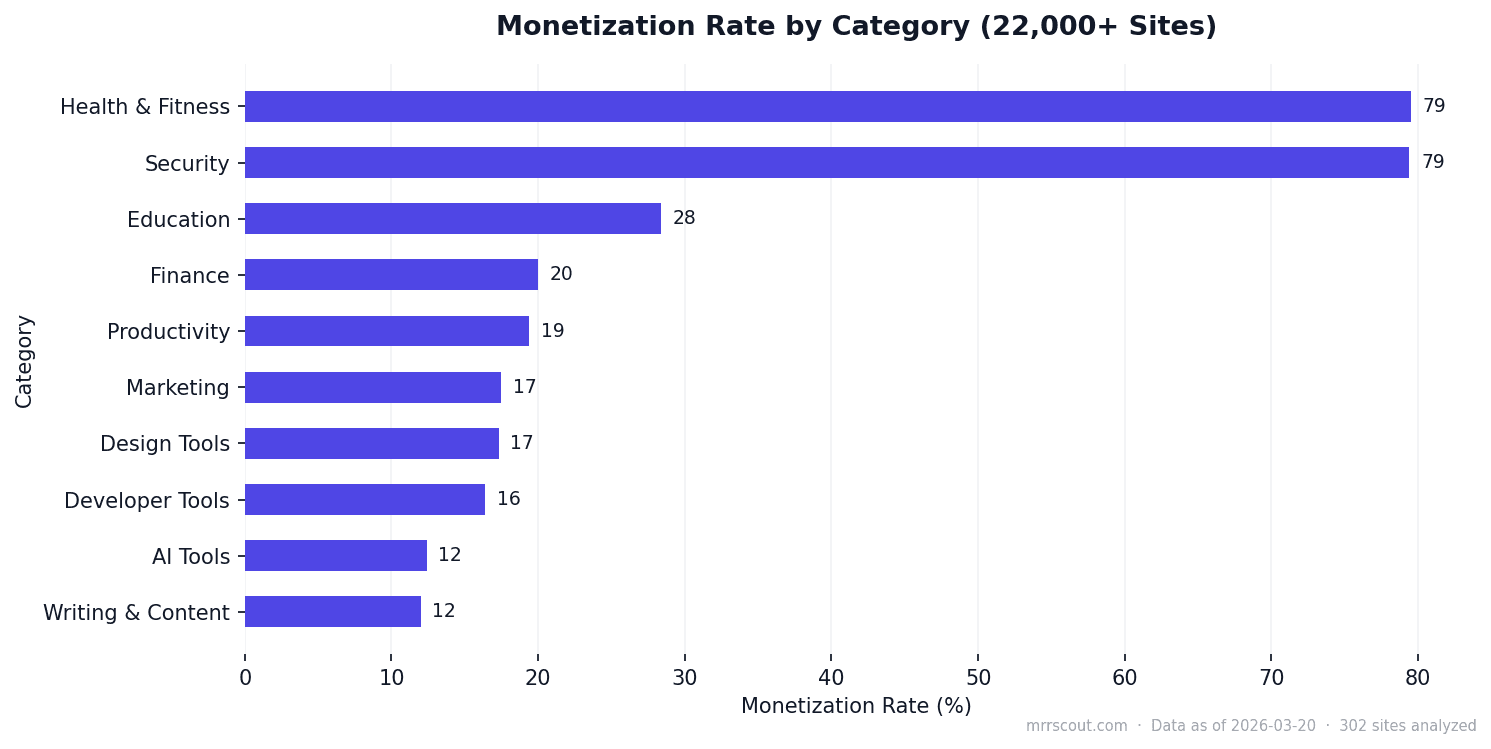
Why These Developer Side Project Ideas Actually Work
A word on methodology first. We define "monetized" as a site with confirmed payment infrastructure detected by our platform — a real payment gateway, a pricing page, or both. We don't count self-reported MRR or waitlists. We also filter to relevance_tier IN (1, 2) — confirmed products and community-validated tools — excluding noise, parked domains, and unclassified sites.
The niches below score well on two dimensions simultaneously: monetization rate (what percentage of existing sites in this space are actually making money) and site count (how many competitors you'd be entering against). High rate + low count = a niche worth building in.
Data as of 2026-03-19, 22,318 effective sites tracked.
10 Developer Side Project Ideas With Real Monetization Data
1. Encrypted Secrets and .env Vault Tools
Category monetization rate: 79.4% (Security) Competition level: Very low — only 34 Security-category sites in our dataset
Every developer has the same problem: .env files sitting in Dropbox, 1Password notes, or worse, a Slack DM. keyra.dev built an encrypted .env vault with team sharing and is already monetized. The niche has near-zero marketing complexity — the target user is the builder themselves.
Security tools discovered through developer communities (Reddit, HN) show some of the highest monetization rates in our data. The buyer is technical, the pain is immediate, and willingness to pay for "never leak a secret again" is well-established.
2. Uptime Monitoring and Status Pages
Category monetization rate: 79.4% (Security / infrastructure overlap) Competition level: Very low — 34 total Security-category sites
encompass.gg launched uptime monitoring with incident management and status pages and is already monetized. The interesting angle in 2026 isn't building another generic uptime monitor — it's targeting a specific stack or audience: Vercel-native apps, Shopify stores, solo founders who need a public status page without paying $40/month to a large vendor.
One-time payment pricing is working well in this space. Buyers are tired of subscriptions for infrastructure tooling.
3. Invoice and Payment Tracking for Freelancers
Category monetization rate: 100% (Finance, Reddit-discovered) Competition level: Low — only 6 Finance sites found via Reddit communities
makeinvoices.app offers free invoice generation with a paid tier. milestage.com specifically targets freelancers doing milestone-based payments — stage-by-stage tracking, client payment status, late payment nudges. Both are monetized.
Finance tools have the fastest monetization speed in our dataset: 56% of Finance SaaS sites generate first revenue within 30 days of domain registration. The buyer already has a payment problem. You're not creating demand, you're capturing it.
4. Personal Finance Calculators With Real Depth
Category monetization rate: 20.0% overall; 100% for Reddit-discovered Finance tools Competition level: Medium — high search volume, but most tools are shallow
buyvsrent.org built a rent-vs-buy calculator with mortgage break-even and home equity modeling. back-test.io built a trading simulator. Both monetized, both solving a specific calculation that existing free tools do poorly.
The formula: take a financial decision people make once but research for weeks, and build the calculator that actually models the complexity. Rent vs buy, early retirement, tax-loss harvesting, stock option vesting — each of these has thousands of monthly searches and weak existing tools.
5. App Store Screenshot Generators
Category monetization rate: 88.2% (Developer Tools, Reddit-discovered) Competition level: Low — clear niche within Developer Tools (2,170 total sites)
screenshototter.com does one thing: generates App Store screenshots from templates. Every iOS and Android developer needs this. The existing tools are either too expensive or too manual (Figma templates).
This is a classic "developer builds for developers" side project: you've felt the pain, you know the workflow, and the buyer is easy to reach on the same Reddit threads and Discord servers you already use.
6. AI Proposal Generators for Agencies and Freelancers
Category monetization rate: 94.7% (AI Tools, Reddit-discovered) Competition level: Low-mid — AI Tools overall has 7,630 sites at 12.4%, but workflow-specific tools are not crowded
proposalmind.online targets agencies and freelancers who write repetitive proposals. It's a narrow vertical within AI writing with clear willingness to pay: agencies charge thousands per project and spend hours on proposals. The ROI math is obvious to the buyer.
AI Tools discovered through Reddit show a 94.7% monetization rate in our data — dramatically higher than the category average of 12.4%. The key differentiator is specificity: "AI for proposals" outperforms "AI writing assistant" on every retention metric.
7. Resume and Job Matching Tools
Category monetization rate: 88.2% (Developer Tools, Reddit-discovered) Competition level: Medium — high demand, but room for niche targeting
matchrezi.com matches resumes to specific job descriptions and highlights gaps. easyresume.site focuses on clean, ATS-friendly formatting. Both monetized, both serving a buyer in active pain who has a clear deadline (a job application they want to submit today).
The developer angle: build for a specific role type. A resume tool for DevOps engineers, ML researchers, or indie hackers pivoting to employment hits a segment that generic resume tools consistently underserve.
8. Niche Job Alert Services
Category monetization rate: 88.2% (Developer Tools, Reddit-discovered) Competition level: Low — few focused services, high automation potential
devjobalerts.io sends real-time job alerts for developers, filtered beyond what LinkedIn and Indeed offer. The product is essentially a Postgres query, a cron job, and an email — and it's monetized.
The opportunity is in specificity: remote-only ML engineering roles that pay above $180k, senior Rust positions at Series A companies, contract iOS work in specific time zones. These are searches people run manually every day. Automating and alerting on them is a one-weekend build with recurring revenue potential.
9. Health Tracking Dashboards
Category monetization rate: 79.5% — among the highest in our dataset Competition level: Extremely low — only 39 Health & Fitness sites tracked
Health & Fitness has one of the highest monetization rates in our data (79.5%), yet only 39 sites exist in the entire category. That ratio — near-universal monetization, minimal competition — is exceptional.
neevhealth.co built a personal health metrics dashboard. ruler.online built a self-tracking tool for mood and behavior. These aren't fitness apps competing with Apple Health — they're specific tracking tools for specific behaviors, and buyers pay for them.
For developers, this is a green-field space. The technical bar is low (charts, forms, local or synced storage), the buyer is motivated, and the category is not yet saturated.
10. Region-Specific Compliance and Regulatory Tools
Category monetization rate: 100% (Finance, Reddit-discovered) Competition level: Extremely low — highly localized, most developers ignore these markets
rentcheckme.com checks U.S. rent control laws and tenant protections by address. It does one thing for one audience in one country, and it's monetized.
These tools work because the information is hard to find, changes frequently, and has real stakes for the user. Regional tax calculators, local business license requirement checkers, state-specific employment law tools — the global equivalents multiply this across every jurisdiction.
We expected AI Tools and Developer Tools to dominate monetization rankings. What we found instead: Health & Fitness (79.5%) and Security (79.4%) significantly outperform the AI Tools category average (12.4%), despite being far smaller categories. The implication for side project selection is direct: don't follow the crowd into crowded categories. Build where monetization is already high and competition is still low.
How to Use This Data to Pick Your Side Project
A few practical frameworks from what the numbers show:
Start with your own pain, validate with category data. Every product on this list solves a problem the builder has personally experienced. But the data adds a filter: if your pain point sits in a low-monetization category, reconsider the angle before building.
Niche specificity beats broad appeal. devjobalerts.io is narrower than LinkedIn. rentcheckme.com is narrower than any legal information site. The narrower product wins because it solves the problem completely for a specific person rather than partially for everyone.
Community-discovered products monetize better. Across every category, Reddit-discovered sites show dramatically higher monetization rates than the category average. Build in public from day one — not for growth hacking, but because the feedback loop compresses your path to product-market fit.
Frequently Asked Questions
What are the best side project ideas for developers in 2026?
Based on monetization data from 22,000+ sites, the highest-opportunity niches are: encrypted secrets management, uptime monitoring, freelancer invoicing tools, health tracking dashboards, and niche job alert services. These combine high monetization rates with very low competition (under 50 sites in several categories).
Which developer side projects make money fastest?
Finance tools monetize fastest in our data — 56% of Finance SaaS products generate first revenue within 30 days of domain registration. Invoicing tools, calculators, and payment tracking apps all fall into this category.
How do I validate a side project idea before building?
Check whether existing products in the niche are already monetized. If the category monetization rate is above 50%, demand is proven. If the total site count is below 200, competition is manageable. Both conditions together — high rate, low count — is the ideal entry point.
Is the AI Tools space too crowded for a developer side project?
The overall AI Tools category has 7,630 sites at just 12.4% monetization — a crowded, low-conversion landscape. But community-validated AI tools (Reddit-discovered) show a 94.7% monetization rate. The play isn't "build an AI tool" — it's "build a highly specific AI tool for a specific workflow and distribute it in the community where that audience already gathers."
What makes a developer side project succeed in 2026?
Our data points to three factors: specificity (narrow niche, specific buyer), distribution alignment (being discovered in the communities your buyer uses), and pricing infrastructure from day one (products launched with a pricing page convert to revenue faster).
How much competition is there in Health & Fitness tools?
Extremely low — only 39 Health & Fitness sites in our effective dataset, with a 79.5% monetization rate. It's the least-crowded high-monetization category we track, and most developers overlook it entirely.
Where does MRRScout's data come from?
All statistics in our articles come from MRRScout's intelligence platform, which continuously monitors 24,000+ newly launched websites across Reddit, Product Hunt, Hacker News, BetaList, certificate transparency logs, and domain activity feeds. Sites are classified as monetized only when active payment infrastructure is detected — not based on self-reported MRR or founder claims. Data snapshots are timestamped in each article. Full database: [mrrscout.com/discover](https://mrrscout.com/discover).
Want to discover rising micro-SaaS before the crowd does?
Join the MRRScout waitlist