March 23, 2026
Which SaaS Niches Actually Make Money? Monetization Rates by Category (2026 Data)
Health & Fitness SaaS monetizes at 81.4%, Security at 70% — yet AI Tools sits at just 12.5%. Here's which niches actually convert to revenue in 2026.
The most popular SaaS niche has the worst monetization rate. That's the short version.
Across 22,849 tracked sites in our platform, AI Tools leads in volume with 7,676 products — and sits dead last with a 12.5% monetization rate. Meanwhile Health & Fitness, with just 43 sites, converts at 81.4%. If you're trying to find a SaaS niche that actually makes money, the data points somewhere very different from where most indie hackers are building.
Here's what the numbers look like when you stop counting products and start counting paying customers.
The SaaS Niches With the Highest Monetization Rates
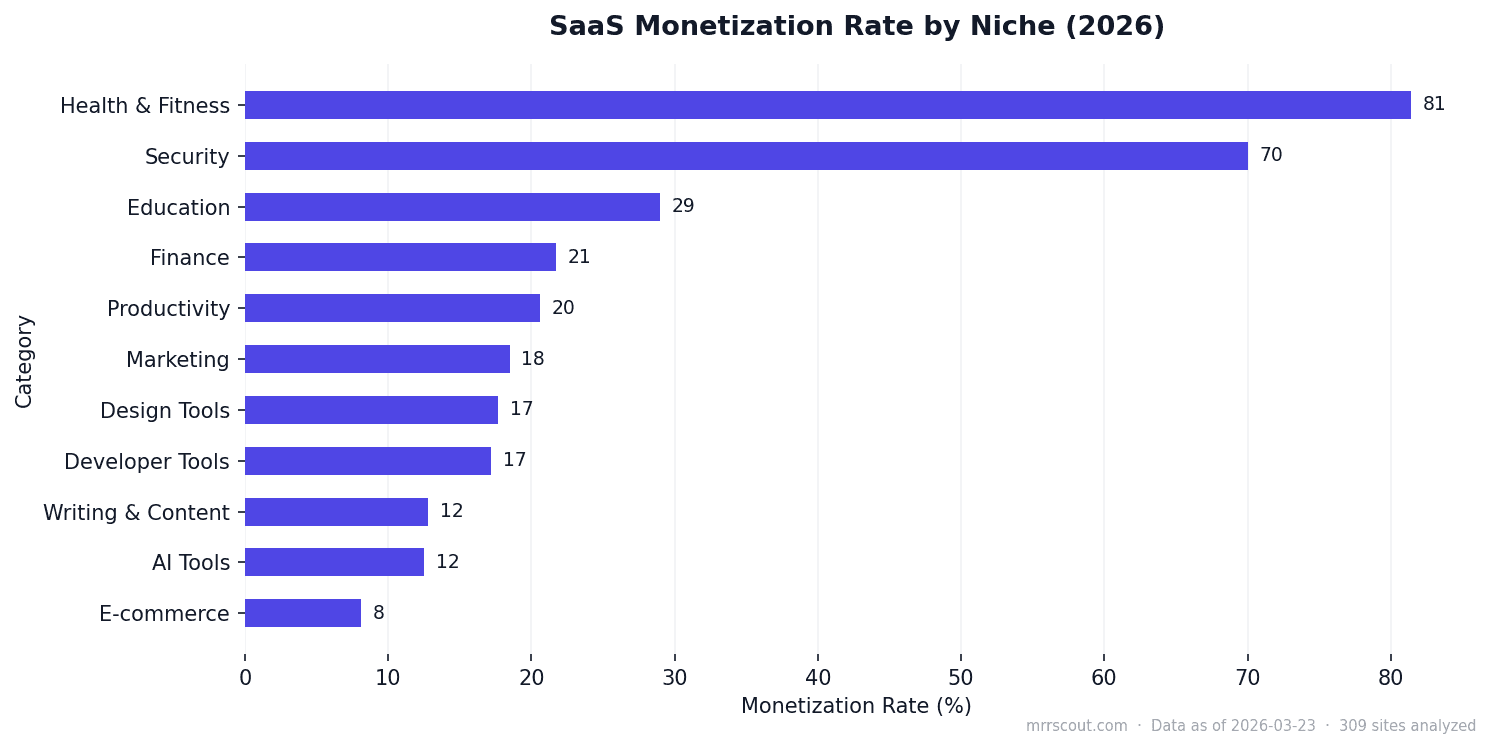
Our platform monitors 22,849 active sites classified across 11 major categories. "Monetized" means our system detected active payment infrastructure — a real payment gateway, a live pricing page, or confirmed billing signals. Not self-reported MRR. Not founder claims. Actual payment infrastructure detected in the wild.
The top performers:
| Category | Sites Tracked | Monetization Rate |
|---|---|---|
| Health & Fitness | 43 | 81.4% |
| Security | 40 | 70.0% |
| Education | 252 | 29.0% |
| Finance | 558 | 21.7% |
| Productivity | 642 | 20.6% |
| Marketing | 774 | 18.5% |
| Design Tools | 2,026 | 17.7% |
| Developer Tools | 2,204 | 17.2% |
| Writing & Content | 694 | 12.8% |
| AI Tools | 7,676 | 12.5% |
| E-commerce | 5,449 | 8.1% |
Data as of 2026-03-23, 22,849 sites tracked (relevance_tier 1–2 only).
Health & Fitness at 81.4% means roughly 4 out of every 5 products in this niche have live payment infrastructure. That's not a fluke — it reflects a user base with demonstrated willingness to pay for outcomes (weight loss, fitness tracking, health monitoring). The problem is clear, the solution is tangible, and users have already been trained to pay for it by gym memberships and personal trainers.
Why AI Tools Dominate Volume But Lag on Revenue
We expected AI Tools to be competitive. The category has attracted massive attention, VC money, and solo-founder energy since 2023. What we found instead was that the sheer volume of new AI tools has severely diluted monetization signals.
In our dataset of 7,676 AI Tools sites, only 12.5% show confirmed payment activity — that's 962 monetized products out of nearly 8,000. The rest are either free-tier plays hoping to convert later, side projects that never got a paying customer, or early-stage products still searching for product-market fit.
The supply-demand imbalance is stark: AI Tools has 178× more products than Health & Fitness but a 6.5× lower monetization rate. Building another AI wrapper into the most crowded category is a volume bet, not a revenue bet.
The Small Niches Worth Watching
Security's 70% monetization rate deserves attention. With only 40 tracked products, the category is dramatically under-supplied relative to demand. Real examples from our platform: securitysense.tech (with a live pricing page and confirmed payment signals), currentvpn.io, and cloud-security.online — all recently launched, all monetizing within days of detection.
The pattern makes sense. Security is a category where users need to pay — free tools create trust concerns. Compliance requirements, data protection obligations, and business risk make security spending non-optional for many buyers. Low supply, non-discretionary demand, high willingness to pay. That combination produces 70% monetization rates.
Education at 29% is another outlier worth noting. With 252 products, it has meaningful sample size, and nearly 1 in 3 sites has active payment infrastructure. Online learning hasn't been "killed" by AI — if anything, AI-augmented tutoring and specialized skill-building tools are finding paying audiences faster than generic tools.
Supply Density vs. Monetization: The Framework
The useful mental model here isn't just "high monetization rate good." It's the relationship between supply density (how many products exist) and monetization rate (what fraction actually make money).
- High density, low rate (AI Tools, E-commerce): Fierce competition, users expect free tiers or low prices, hard to stand out
- Low density, high rate (Health & Fitness, Security): Underserved demand, users already pay in adjacent categories, faster path to first revenue
- Mid density, mid rate (Finance, Productivity, Marketing): Established markets with real buyers, competitive but not saturated
For solo founders or small teams going to market, the low-density/high-rate quadrant is where the asymmetric opportunity lives. Not because building in Health & Fitness is easier — it's not — but because the competitive pressure per potential customer is far lower.
What This Means for Finding Your Product Direction
The data suggests a counter-intuitive rule: build where the money already flows, not where the builders are.
Every developer building an AI writing tool is competing against 694 other writing tools and 7,676 AI tools simultaneously. Every developer building a fitness tracking tool for a specific niche (CrossFit coaches, postpartum recovery, corporate wellness) is entering a category where 81% of their few competitors already have paying customers.
A practical framework based on what we're seeing in the data:
- Check monetization rate first — Does the category have a track record of payment? Security and Health & Fitness do. E-commerce SaaS doesn't.
- Count the competition — How many products exist in your specific niche? The fewer, the better the signal-to-noise ratio for potential customers.
- Look for adjacent payment behavior — Users who already pay for gyms, therapy apps, or enterprise security tools are pre-validated buyers. You're not teaching them to pay; you're offering a better option.
- Validate with real platform signals — Not just Reddit votes or ProductHunt upvotes. Actual payment infrastructure detected in the wild is the hardest signal to fake.
We found real-world examples supporting this pattern: neevhealth.co and gymapp.cloud both showed up in our platform with confirmed monetization signals within days of launch — not weeks or months. The health niche is not just monetizing at higher rates; it's doing it faster.
One honest caveat: our Health & Fitness sample (43 sites) is smaller than AI Tools (7,676). The high monetization rate could partly reflect selection bias — only serious products in this niche gain enough signal to be tracked. We're watching this category closely as sample size grows.
Frequently Asked Questions
Which SaaS niche has the highest monetization rate in 2026?
Based on our platform data, Health & Fitness leads at 81.4%, followed by Security at 70.0%. Both categories have small product counts relative to their monetization rates, suggesting underserved demand.
What is the best SaaS niche to build in 2026?
The data favors low-density, high-monetization categories: Health & Fitness and Security both show strong payment signals with relatively few competing products. Finance (21.7%) and Productivity (20.6%) are solid mid-tier options with larger validated markets.
Why do AI Tools have such a low monetization rate?
In our dataset of 7,676 AI Tools sites, only 12.5% show confirmed payment activity. The category is over-supplied — too many products competing for attention means users expect free tiers, and many products never convert to paid. Volume doesn't equal revenue in this niche.
How is "monetized" defined in MRRScout's data?
A site is classified as monetized when our platform detects active payment infrastructure — a confirmed payment gateway, live billing system, or active pricing page. This is based on platform signals, not self-reported revenue or founder claims.
Does a high monetization rate mean a niche is easy to compete in?
Not necessarily. Health & Fitness and Security require domain trust and often regulatory awareness. High monetization rates indicate *user willingness to pay*, not low barriers to entry. The advantage is that buyers in these categories are already paying for solutions — you're competing for share, not educating the market.
How often is this data updated?
Our platform monitors sites continuously. The data in this article reflects a snapshot as of 2026-03-23, covering 22,849 sites classified at relevance tier 1 or 2 (confirmed or potential products — noise and unclassified sites excluded).
What categories are growing fastest in new product launches?
AI Tools continues to dominate new entries. We're tracking emerging signals in Health & Fitness and Security with newly launched products showing fast paths to payment detection — sometimes within days of first being seen by our platform.
Where does MRRScout's data come from?
All statistics in our articles come from MRRScout's intelligence platform, which continuously monitors 24,000+ newly launched websites across Reddit, Product Hunt, Hacker News, BetaList, certificate transparency logs, and domain activity feeds. Sites are classified as monetized only when active payment infrastructure is detected — not based on self-reported MRR or founder claims. Data snapshots are timestamped in each article. Full database: [mrrscout.com/discover](https://mrrscout.com/discover).
Want to discover rising micro-SaaS before the crowd does?
Join the MRRScout waitlist