March 17, 2026
Which SaaS Categories Have the Highest Monetization Rate in 2026?
Education and Health & Fitness SaaS monetize at 17.8% — nearly 3× the rate of E-commerce. Data from 35,000+ sites tracked in March 2026.
Education and Health & Fitness SaaS have the highest monetization rates of any category in 2026 — both sitting at 17.8% according to our platform data. That means nearly 1 in 5 newly detected sites in these categories already has active payment infrastructure. The more popular categories — AI Tools, E-commerce — are nowhere close.
We analyzed 35,480 websites detected by our intelligence platform during March 2026. These are sites identified through passive monitoring of certificate transparency logs and domain activity feeds — not submitted by founders, not filtered by popularity. It's as close to an unbiased sample of the live web as we can get.
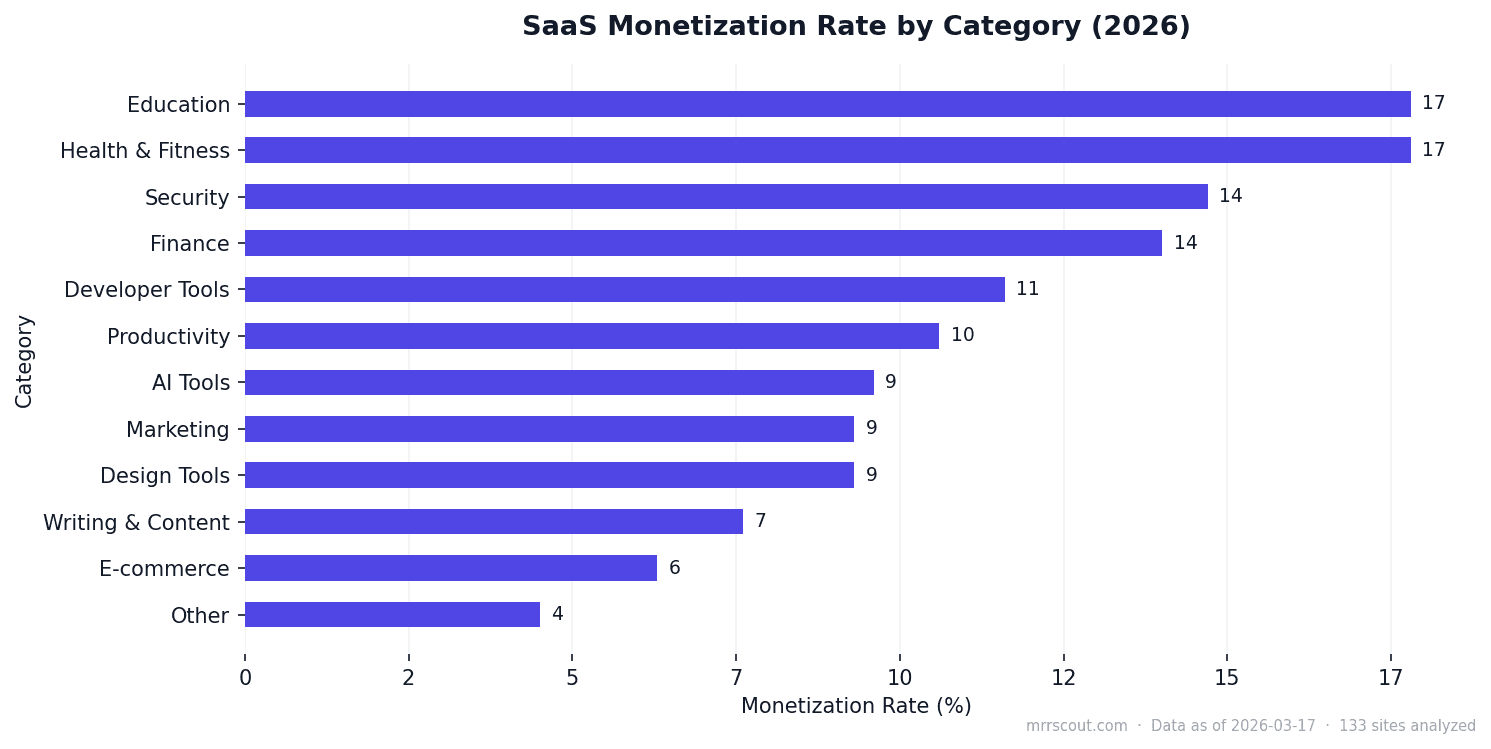
Education and Health Lead — By a Wide Margin
In our dataset of 35,480 sites tracked in March 2026, Education (163 sites, 17.8% monetized) and Health & Fitness (73 sites, 17.8% monetized) sit at the top. That's not a rounding artifact — it's consistent across both categories independently.
Examples from our monitored universe: dreamlore.app, learnlabs.tech, and httech.cloud all fall into Education and all show active payment signals. On the Health side, gymapp.cloud and shouhealth.app are among the recently detected monetized sites.
Security (14.7%) and Finance (14.0%) round out the top tier. These four categories share a trait: they sell outcomes people will pay for — skills, health, safety, money. The purchase decision is easier when the stakes are real.
AI Tools at 9.6%: Popular but Not Dominant
We expected AI Tools to rank higher. It's the fastest-growing category by volume (5,845 sites in our March snapshot), and founder energy is concentrated there. What we found instead was a monetization rate of 9.6% — roughly half of Education and Health.
The volume tells part of the story. When a category is easy to enter, a lot of non-serious projects pile in. AI Tools has nearly 36× more sites than Education in our dataset. More sites means more experimental, unfinished, or stalled products dragging the rate down. That doesn't mean AI Tools is a bad bet — it means the signal-to-noise ratio is lower, and standing out requires more than just launching.
E-commerce: The Category With the Lowest Signal
E-commerce has 5,173 sites in our dataset — the second largest category — with a monetization rate of just 6.3%. That's below the overall average of 6.5% for the full urlscan sample.
This is partly a definitional issue: many E-commerce sites in our dataset are storefronts that haven't launched, template sites, or dropshipping shells that never shipped a product. The category label captures a wide range of intent. A monetization rate below 7% suggests a lot of those sites never convert from "project" to "business."
The Long Tail: "Other" at 4.5%
Nearly 55% of the sites in our March dataset fall into the "Other" category — 19,278 sites with a 4.5% monetization rate. These are the hardest sites to classify and likely include the largest share of abandoned or experimental projects.
The takeaway: category classification itself is a signal. A site with a clear, recognizable category is more likely to have been deliberately built. Uncategorized sites often lack the focus that drives monetization.
What This Means for Founders Choosing a Market
The data has a clear message: niche markets with high personal stakes monetize faster. Education teaches skills. Health improves lives. Security protects businesses. Finance grows money. People pay for these things without much convincing.
Chasing AI Tools because it's trendy, or E-commerce because the playbooks are well-known, doesn't guarantee monetization. In our dataset, those categories have twice the noise and half the signal compared to Education or Health.
One important caveat: our sample from March 2026 reflects a specific two-week window of newly detected sites. Education and Health & Fitness have smaller absolute counts (163 and 73 respectively), so the rates could shift with more data. But the directional finding — that outcome-oriented categories monetize faster — is consistent with what we've observed across multiple monitoring cycles.
Frequently Asked Questions
Which SaaS category has the highest monetization rate in 2026?
Based on our March 2026 dataset of 35,480 sites, Education and Health & Fitness are tied at 17.8% — the highest of any category with meaningful sample size.
Why do AI Tools have a lower monetization rate than Education or Health SaaS?
AI Tools has far more sites (5,845 vs 163 for Education), which means a larger proportion of unfinished or experimental projects. Higher volume categories tend to have lower average monetization rates because the barrier to entry is lower.
Is E-commerce a good SaaS category to build in?
By monetization rate alone, E-commerce ranks near the bottom at 6.3% in our dataset. That said, successful E-commerce SaaS businesses exist — the data just shows that most new entrants don't reach monetization.
What does "monetized" mean in MRRScout's data?
A site is classified as monetized only when our platform detects active payment infrastructure — Stripe checkout flows, payment gateway integrations, or similar signals. Self-reported MRR or pricing pages alone don't qualify.
Does having a pricing page correlate with monetization?
In our dataset, Education sites have an 8% pricing page rate but 17.8% monetization rate. This suggests many Education SaaS products charge without a traditional public pricing page — likely through trial flows or onboarding-gated pricing.
Should I build in a low-volume niche category instead of AI Tools?
The data suggests yes, if monetization speed matters. Categories like Education and Health have higher monetization rates, lower competition by volume, and clearer buyer intent. The tradeoff is smaller total addressable market.
Where does MRRScout's data come from?
All statistics in our articles come from MRRScout's intelligence platform, which continuously monitors 24,000+ newly launched websites across Reddit, Product Hunt, Hacker News, BetaList, certificate transparency logs, and domain activity feeds. Sites are classified as monetized only when active payment infrastructure is detected — not based on self-reported MRR or founder claims. Data snapshots are timestamped in each article. Full database: [mrrscout.com/discover](https://mrrscout.com/discover).
Want to discover rising micro-SaaS before the crowd does?
Join the MRRScout waitlist