March 30, 2026
Productivity SaaS Outmonetizes AI Tools — And Nobody's Talking About It (2026 Data)
Productivity SaaS monetizes at 19.6% vs AI Tools' 12.3%. Data from 24,000+ sites shows why this overlooked category beats the most hyped niche in 2026.
Productivity SaaS has a higher monetization rate than AI Tools. Not by a little — by 59%. While the internet keeps building AI writing assistants and chatbot wrappers, a quieter category is converting visitors into paying customers at a significantly higher rate.
We tracked 24,066 newly launched websites across our intelligence platform and measured actual payment infrastructure — not self-reported MRR, not pitch decks. Here's what the productivity SaaS monetization data actually shows.
Productivity SaaS by the Numbers
In our dataset of 24,066 high-relevance sites, Productivity SaaS converts at 19.6% — meaning roughly 1 in 5 tracked productivity tools has detected payment infrastructure. AI Tools sits at 12.3%. That's a 59% gap in favor of the less-hyped category.
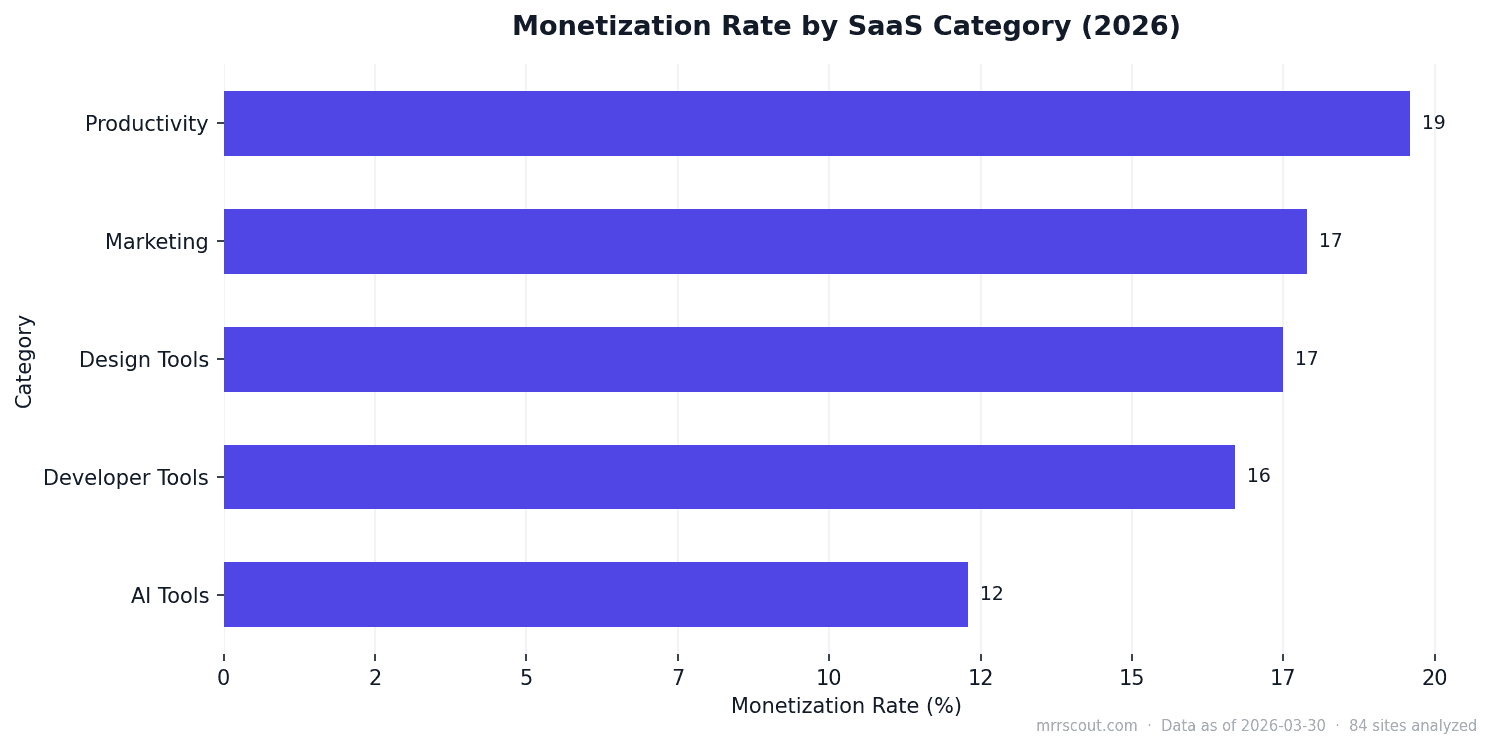
The full ranking among mid-size categories:
- Productivity: 19.6% (674 sites)
- Marketing: 17.9% (809 sites)
- Design Tools: 17.5% (2,094 sites)
- Developer Tools: 16.7% (2,279 sites)
- AI Tools: 12.3% (7,899 sites)
Data as of 2026-03-30, 24,066 sites tracked.
The 31–90 Day Window Is Where It Gets Interesting
We expected new productivity tools to struggle early — getting traction, finding customers, iterating on pricing. What we found instead was that Productivity SaaS peaks fastest.
Among sites registered 31–90 days ago, Productivity converts at 26.4%. Compare that to AI Tools at 21.3% in the same cohort. Design Tools leads at 29.1%, but it's a more mature, tool-heavy category.
Why does this matter? Because 44.7% of all Productivity sites in our platform are under 90 days old. This isn't a stagnant, saturated category — it's actively growing and converting well from the start.
Pricing Page Density: A Quiet Advantage
One proxy for "serious product" is whether a site has a dedicated pricing page. In our dataset, having a pricing page correlates with a 72.2% monetization rate vs 13% without one.
Productivity SaaS has a pricing page density of 13.9% — more than double AI Tools (6.6%) and higher than Developer Tools (7.5%), Design Tools (8.2%), or Marketing (10.8%).
In other words: productivity founders are more likely to commit to a pricing structure early. That's not a coincidence — it reflects a clearer value proposition and a buyer who already knows they're paying for workflow improvement.
Real Sites, Real Revenue
Among recently monetized Productivity tools we've tracked:
- tracking.sh — registered October 2025, payment detected within 90 days. A developer-focused tracking utility with a clean pricing page.
- simurg.app — registered February 2026, monetized by mid-March. Fast path from launch to revenue.
- ghost-desk.app — no registered date in our records, but payment infrastructure and pricing page both detected in mid-March 2026.
These aren't unicorns. They're representative of the 132 monetized productivity sites in our dataset — small tools solving specific workflow problems, with clear pricing and active payment infrastructure.
Why Productivity Tools Monetize Better
We think there are a few structural reasons:
Pain is specific and immediate. A productivity tool solves "I waste 2 hours a day on X." That's a concrete problem with a calculable ROI. AI tools often solve "make things easier" — which is harder to price and easier to defer buying.
Buyers already have budget. Teams and individuals buying productivity tools are used to paying for software. Notion, Linear, Superhuman — they've trained the market. AI tools are still fighting the "why pay when GPT-4 is free" objection.
Feature scope is scoped. A productivity SaaS doesn't need to compete with OpenAI. It needs to be the best tool for one workflow. That's a winnable market.
What This Doesn't Mean
We want to be careful about one thing: small categories can look exceptional because of selection bias. Health & Fitness converts at 71.4% — but there are only 49 sites in our dataset. The Productivity category (674 sites) is large enough to be meaningful, but it's still not AI Tools-scale (7,899 sites).
Also, monetization rate measures whether a site has payment infrastructure — not how much revenue it generates. A $9/month solo tool counts the same as a $99/month team plan.
Still: 19.6% vs 12.3% across 674 vs 7,899 sites is a real signal, not noise.
The Market Is Still Wide Open
44.7% of Productivity sites in our database are under 90 days old. The category is not mature or saturated. It's in active expansion — and the tools entering it are converting at higher rates than the dominant category everyone is chasing.
If you're choosing between building your next AI wrapper or a focused productivity tool for a specific workflow, the data suggests the less trendy path might be the smarter bet.
Frequently Asked Questions
What is the monetization rate for productivity SaaS in 2026?
In our dataset of 24,000+ sites, Productivity SaaS has a monetization rate of 19.6% — meaning roughly 1 in 5 tracked productivity tools has active payment infrastructure detected.
How does productivity SaaS compare to AI tools in terms of monetization?
Productivity SaaS monetizes at 19.6% vs AI Tools at 12.3% — a 59% gap in favor of Productivity. In the 31–90 day window, Productivity tools convert at 26.4% vs AI Tools at 21.3%.
Should I build a productivity tool or an AI tool in 2026?
Based on monetization data alone, Productivity SaaS consistently outperforms AI Tools. However, category choice isn't the only factor — your unfair advantage, distribution, and specific niche matter more than category averages.
Why do productivity tools have a higher monetization rate?
Likely because the value proposition is concrete (saving time on a specific task), buyers already have SaaS budgets, and the category doesn't face the "why pay when AI is free" objection that AI-first tools encounter.
Is productivity SaaS a saturated market?
Not based on our data. 44.7% of Productivity sites in our platform are under 90 days old, suggesting active expansion rather than saturation.
What percentage of productivity tools have a pricing page?
13.9% of Productivity SaaS sites in our dataset have a dedicated pricing page — more than double the rate of AI Tools (6.6%). This higher commitment to transparent pricing likely contributes to the better conversion rates.
What makes a productivity SaaS more likely to monetize?
Having a pricing page is the strongest predictor: productivity tools with a pricing page convert at 52.1% vs the category average of 19.6%. Beyond that, sites discovered 31–90 days after registration show the highest monetization rates (26.4%).
Where does MRRScout's data come from?
All statistics in our articles come from MRRScout's intelligence platform, which continuously monitors 24,000+ newly launched websites across Reddit, Product Hunt, Hacker News, BetaList, and other discovery channels. Sites are classified as monetized only when active payment infrastructure is detected — not based on self-reported MRR or founder claims. Data snapshots are timestamped in each article. Full database: [mrrscout.com/discover](https://mrrscout.com/discover).
Want to discover rising micro-SaaS before the crowd does?
Join the MRRScout waitlist