March 25, 2026
New Domains Monetize Faster: 20% of Sites Under 90 Days Old Are Already Charging (2026 Data)
New domains under 90 days old monetize at 20%—43% higher than 1-2 year old domains. Data from 20,800+ sites reveals why fresh registrations outperform aged domains in 2026.
Domains registered in the last 90 days have a higher monetization rate than those that are one, two, or even three years old. We analyzed 20,800+ sites across our intelligence platform and found that new domain monetization rate peaks early — then drops, and only partially recovers with age.
The number: 20.0% of sites with domains under 90 days old are already charging customers. That's 43% higher than domains aged 1–2 years (14.0%). If you've been waiting to register that domain until you're "ready," the data suggests you're probably waiting too long.
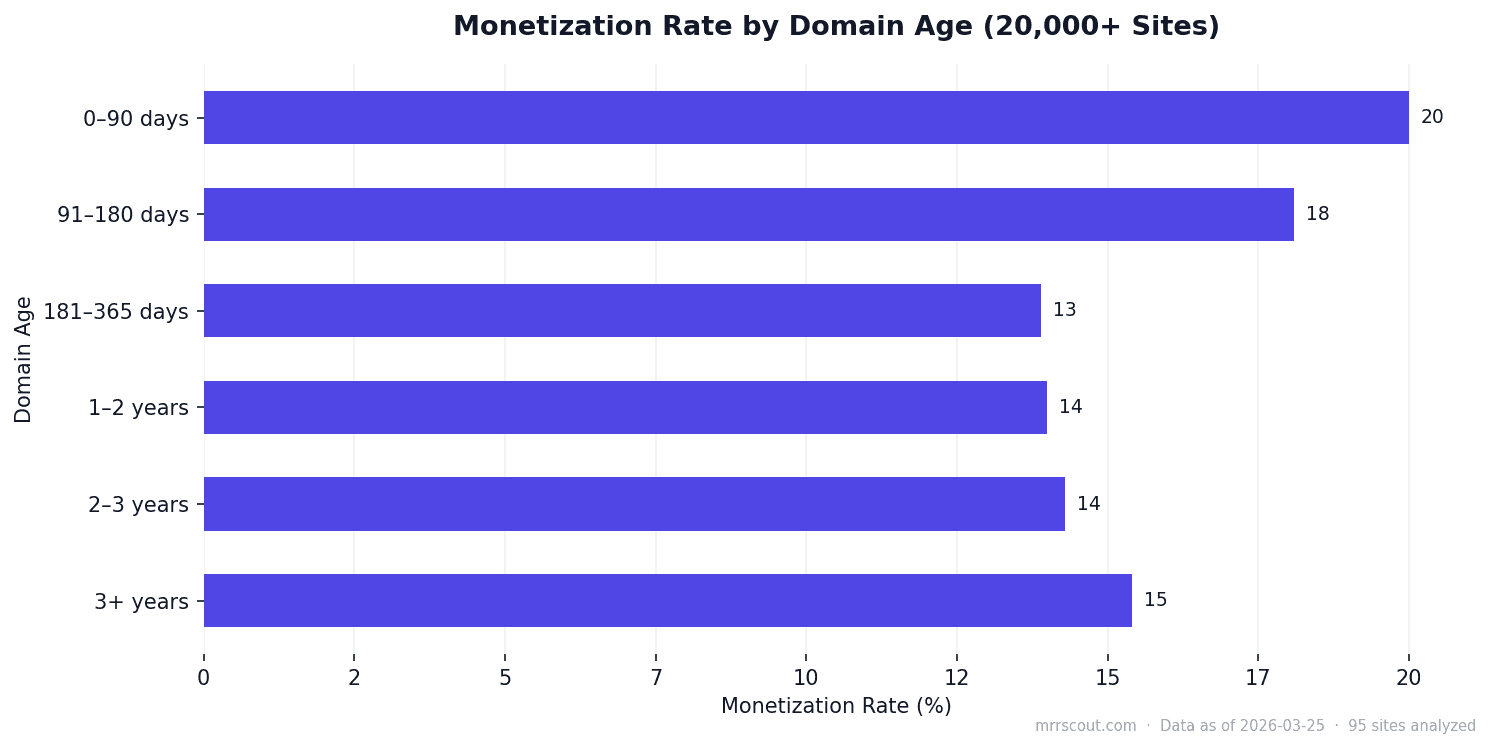
Domain Age vs. Monetization Rate: What the Numbers Show
Here's the full breakdown across 20,847 sites with known domain registration dates (data as of 2026-03-25):
| Domain Age | Sites | Monetized | Rate |
|---|---|---|---|
| 0–90 days | 11,231 | 2,245 | 20.0% |
| 91–180 days | 1,456 | 264 | 18.1% |
| 181–365 days | 2,411 | 336 | 13.9% |
| 1–2 years | 1,798 | 251 | 14.0% |
| 2–3 years | 946 | 135 | 14.3% |
| 3+ years | 2,950 | 453 | 15.4% |
The pattern is clear: monetization rate starts high, falls sharply after 6 months, bottoms out around the 1–2 year mark, then slightly recovers for older domains. It's not a gradual decline — it's a cliff after 180 days.
Why? Our working hypothesis is survivorship selection. Founders who register a domain and immediately set up payment infrastructure are signaling genuine commercial intent from day one. Sites that sit around for 6–18 months without monetizing tend to be experiments that never converted. The ones that make it past 3 years have usually sorted themselves into real businesses.
New Domain Monetization Rate Wins in Most Categories — But Not All
We expected new domains to simply outperform old ones across the board. What we found instead was more nuanced.
In four out of six major categories, newer domains do show higher monetization rates:
- Finance: new domains 24.6% vs old 11.9% — a 2× gap
- Design Tools: new 19.7% vs old 15.8%
- Developer Tools: new 17.9% vs old 14.2%
- AI Tools: essentially tied — new 12.7% vs old 12.8%
But two categories flip the pattern entirely:
- E-commerce: old domains win — 12.7% vs just 7.3% for new ones
- Marketing: old domains win — 25.3% vs 16.8% for new ones
The E-commerce reversal makes intuitive sense. Building a store with real paying customers takes time — inventory, SEO, customer trust. A 3-day-old .store domain almost certainly isn't generating revenue from a real customer base. Older e-commerce properties have had time to build what actually drives sales.
Marketing tools tell a different story. The older, surviving Marketing SaaS products are likely established tools with steady customer bases. The newer ones are still finding product-market fit.
The 0–90 Day Window: Who's Actually Monetizing That Fast?
Skeptical that a domain registered last week could already have paying customers? So were we. But across 11,231 sites in the 0–90 day cohort, 2,245 show confirmed payment infrastructure — meaning our platform detected an active payment gateway, not just a pricing page.
Real examples from the dataset:
dreamscribe.ai(AI Tools) — payment system detected the same day the domain was registeredrimsafe.co(AI Tools) — monetized within 1 day of registrationcodearchaeology.ai(AI Tools) — monetized within 1 day of registrationpostq.co(Marketing) — payment gateway live within 1 day
These aren't flukes. Founders who register a domain already know what they're building, have tested the concept, and wire up Stripe or Paddle immediately. The domain registration is almost the last step, not the first.
What This Means for Indie Hackers
The conventional wisdom — validate first, register a domain when you're serious — may be exactly backwards. Founders who monetize fast seem to treat domain registration as a commitment signal, not a milestone.
A few practical reads from the data:
Register and monetize in the same sprint. The 0–90 day cohort has a 20% monetization rate. The 91–180 day group drops to 18.1%. By 6–12 months, you're at 13.9%. Whatever momentum you have at launch is your highest-probability window.
Finance and Design Tools reward early movers most. Finance SaaS founders with new domains monetize at 24.6% — more than double the rate of older Finance domains. If you're building in those categories, speed is a genuine differentiator.
E-commerce is the exception. Don't read the overall trend as applying to stores. Aged domains in E-commerce outperform new ones by 74%. Customer trust and SEO take time to build there.
AI Tools are neutral. Age doesn't predict monetization for AI tools — new and old domains are nearly identical at ~12.7–12.8%. In that category, what you build matters more than when you registered.
One Data Caveat Worth Noting
This analysis has a meaningful limitation: we can only measure when our platform first detected payment infrastructure, not when the product actually started selling. Some new domains in the dataset may have been registered for a project that was already selling under a different domain, then migrated. The "0–90 day" cohort likely skews toward technically capable founders who set up infrastructure quickly — not necessarily founders who built and sold in 90 days from a standing start.
With that said, the directional signal is consistent across 11,000+ sites and stable across six major categories. It's not noise.
Frequently Asked Questions
Do newer domains monetize faster than older ones?
Yes, on average. Domains under 90 days old monetize at 20.0% across our dataset of 20,800+ sites — 43% higher than the 14.0% rate for 1–2 year old domains. The gap narrows but persists for most categories.
What domain age has the highest SaaS monetization rate?
0–90 days, at 20.0%. Monetization rate drops to 13.9–14.3% for domains between 6 months and 3 years old, then slightly recovers to 15.4% for domains over 3 years.
Why would a brand-new domain already have paying customers?
Founders who register a domain quickly and immediately set up payment infrastructure are self-selecting — they typically have a clear product concept, sometimes an existing audience, and treat the domain as a launch signal rather than a planning step.
Is this true for all SaaS categories?
No. E-commerce and Marketing SaaS are exceptions where older domains outperform newer ones. New domains win in Finance (2×), Design Tools, and Developer Tools. AI Tools are roughly neutral.
Should I register my domain earlier than I planned?
The data doesn't tell you to rush, but it does suggest that letting a domain age without monetizing is associated with lower eventual monetization rates. Founders who move fast from registration to payment setup tend to convert at higher rates.
What counts as "monetized" in MRRScout's data?
A site is classified as monetized only when our platform detects active payment infrastructure — a verified payment gateway integration. This excludes self-reported MRR, "coming soon" pricing pages, or affiliate-only revenue.
Where does MRRScout's data come from?
All statistics in our articles come from MRRScout's intelligence platform, which continuously monitors 24,000+ newly launched websites across Reddit, Product Hunt, Hacker News, BetaList, certificate transparency logs, and domain activity feeds. Sites are classified as monetized only when active payment infrastructure is detected — not based on self-reported MRR or founder claims. Data snapshots are timestamped in each article. Full database: [mrrscout.com/discover](https://mrrscout.com/discover). --- *Explore the full dataset at [mrrscout.com/discover](https://mrrscout.com/discover).*
Want to discover rising micro-SaaS before the crowd does?
Join the MRRScout waitlist