March 9, 2026
The Unofficial Tech Stack of Monetized Micro-SaaS in 2026
We analyzed the tech stacks of over 800 monetized micro-SaaS products to find a clear winner. Here's the data on what indie hackers are actually using to build profitable projects.
If you're an indie hacker, choosing a tech stack is a high-leverage decision. Pick the right one, and you can ship fast. Pick the wrong one, and you'll get bogged down in technical debt before you even find product-market fit. We analyzed the tech stacks of over 800 monetized websites in our database to see what's actually being used to build profitable products in 2026.
The results are surprisingly consistent. A clear pattern has emerged around a modern, frontend-focused stack that prioritizes developer experience and rapid iteration.
The Go-To Stack for Profitable Projects
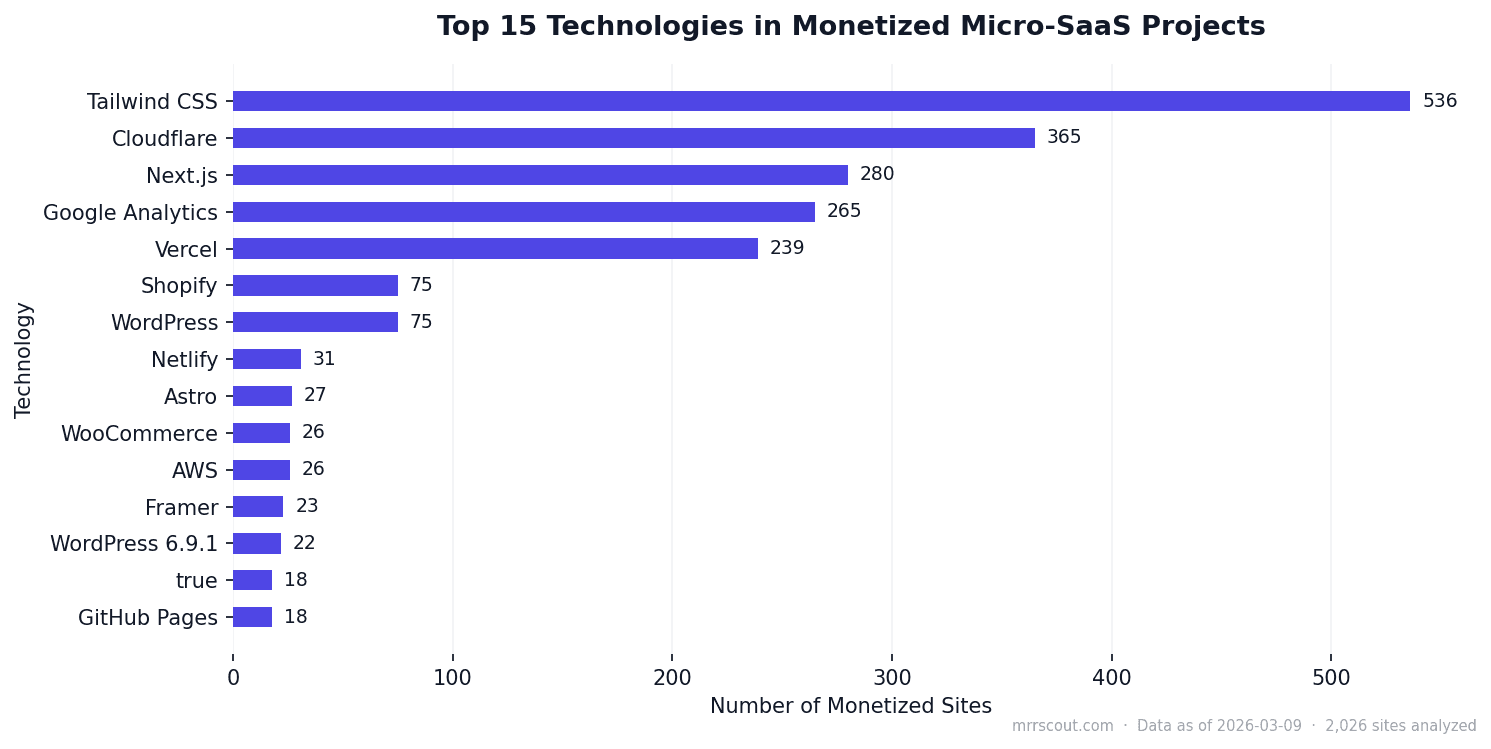
The data speaks for itself. The combination of a React-based framework (overwhelmingly Next.js), styled with Tailwind CSS, and deployed on Vercel or Cloudflare isn't just a trend—it's becoming the default for a reason.
In our dataset of over 24,000 sites, this stack appears more frequently among monetized products than any other combination.
Why This Stack Dominates
We believe this combination is so popular for a few key reasons:
- Component-Driven UI: Next.js (built on React) makes it easy to build complex UIs from small, reusable components. This is ideal for SaaS applications.
- Utility-First CSS: Tailwind CSS avoids the mess of traditional CSS files. You build designs directly in your HTML, which is much faster for solo founders and small teams. Over 536 monetized sites in our dataset use it.
- Simplified DevOps: Vercel and Cloudflare have turned deployments from a weekend-long chore into a single
git push. They handle the scaling, the CDN, and the serverless functions, letting builders focus on the product. These two platforms host over 600 of the monetized sites we track.
This entire stack is built for speed, which is the ultimate advantage for an indie hacker.
The "Boring" Stack Wins
There are newer, flashier tools out there. But when it comes to building a business, "boring" and reliable often wins. Choosing a popular stack means better documentation, more community support, and a larger pool of tutorials and libraries.
Real-World Examples
This isn't just theoretical. Here are a few examples of monetized products from our database running this exact stack:
- poteam.pro: A productivity tool built with Next.js and Tailwind.
- sidestackers.com: A platform for indie hackers, also using Next.js.
- whatsapp-messaging.retentionstack.agency: A SaaS agency product leveraging the speed of this modern stack.
These businesses are focused on solving a customer problem, not on reinventing their tech stack.
What We Expected vs. What We Found
We expected to see a wider variety of backend frameworks like Ruby on Rails, Django, or Laravel in the top 15. Their low ranking was a surprise and suggests a major shift towards Jamstack and serverless architectures for new SaaS products. We also noted that WordPress and Shopify still appear frequently, confirming their roles as powerful platforms for specific types of online businesses, but they are not the typical choice for a ground-up SaaS build.
It's important to acknowledge a limitation in our data: our analysis is based on technology that is publicly detectable. Some backend technologies or internal tools won't be visible to our monitoring platform. Data as of 2026-03-09, from over 24,000 sites tracked.
Frequently Asked Questions
Is Next.js the best framework for Micro-SaaS?
The data shows it's the most *popular* choice for recently launched, monetized products. Its balance of features, performance, and developer experience makes it a very strong candidate.
Do I have to use Tailwind CSS?
No, but it solves a lot of common CSS pain points for solo developers. Its popularity means there's a huge ecosystem of pre-built components and tutorials available.
Is Vercel or Cloudflare better for hosting?
Both are excellent and offer generous free tiers. Vercel is built by the creators of Next.js and offers a seamless experience. Cloudflare has a massive global network and offers more services beyond just hosting.
What about a backend?
Many products using this stack leverage serverless functions (which Vercel and Cloudflare provide) or a backend-as-a-service like Supabase or Firebase to handle database and authentication needs.
Can I use something else, like Vue or Svelte?
Absolutely. The most important thing is to ship your product. However, choosing the most popular stack has benefits in terms of community support and hiring if your team grows.
Where does MRRScout's data come from?
All statistics in our articles come from MRRScout's intelligence platform, which continuously monitors 24,000+ newly launched websites across Reddit, Product Hunt, Hacker News, BetaList, certificate transparency logs, and domain activity feeds. Sites are classified as monetized only when active payment infrastructure is detected — not based on self-reported MRR or founder claims. Data snapshots are timestamped in each article. Full database: [mrrscout.com/discover](https://mrrscout.com/discover). --- Ready to find the next big thing? [Check out MRRScout](https://mrrscout.com/discover).
Want to discover rising micro-SaaS before the crowd does?
Join the MRRScout waitlist