March 16, 2026
The 90-Day Window: When Micro-SaaS Monetization Peaks (And Why Older Sites Earn Less)
Micro-SaaS monetization peaks at 12.7% for sites 31–90 days old — 2× higher than new launches and above year-old sites. Data from 33,000+ tracked sites.
Micro-SaaS monetization peaks not at launch, and not after a year of traction — it peaks between 31 and 90 days after a domain is registered. In our dataset of 33,677 active sites, that window shows a 12.7% monetization rate, nearly double the rate for brand-new sites and meaningfully higher than sites that have been live for over a year.
That's the counter-intuitive finding. And it has direct implications for how indie hackers should think about launch timing, pricing rollout, and competitive monitoring.
The Data: A Clear Peak, Then Decline
Here's what the monetization rate looks like across domain age buckets, based on MRRScout platform data:
| Domain Age | Sites Tracked | Monetization Rate |
|---|---|---|
| 0–30 days | 16,162 | 6.5% |
| 31–90 days | 3,086 | 12.7% |
| 91–180 days | 2,121 | 9.7% |
| 181–365 days | 4,063 | 7.1% |
| 365+ days | 8,245 | 9.1% |
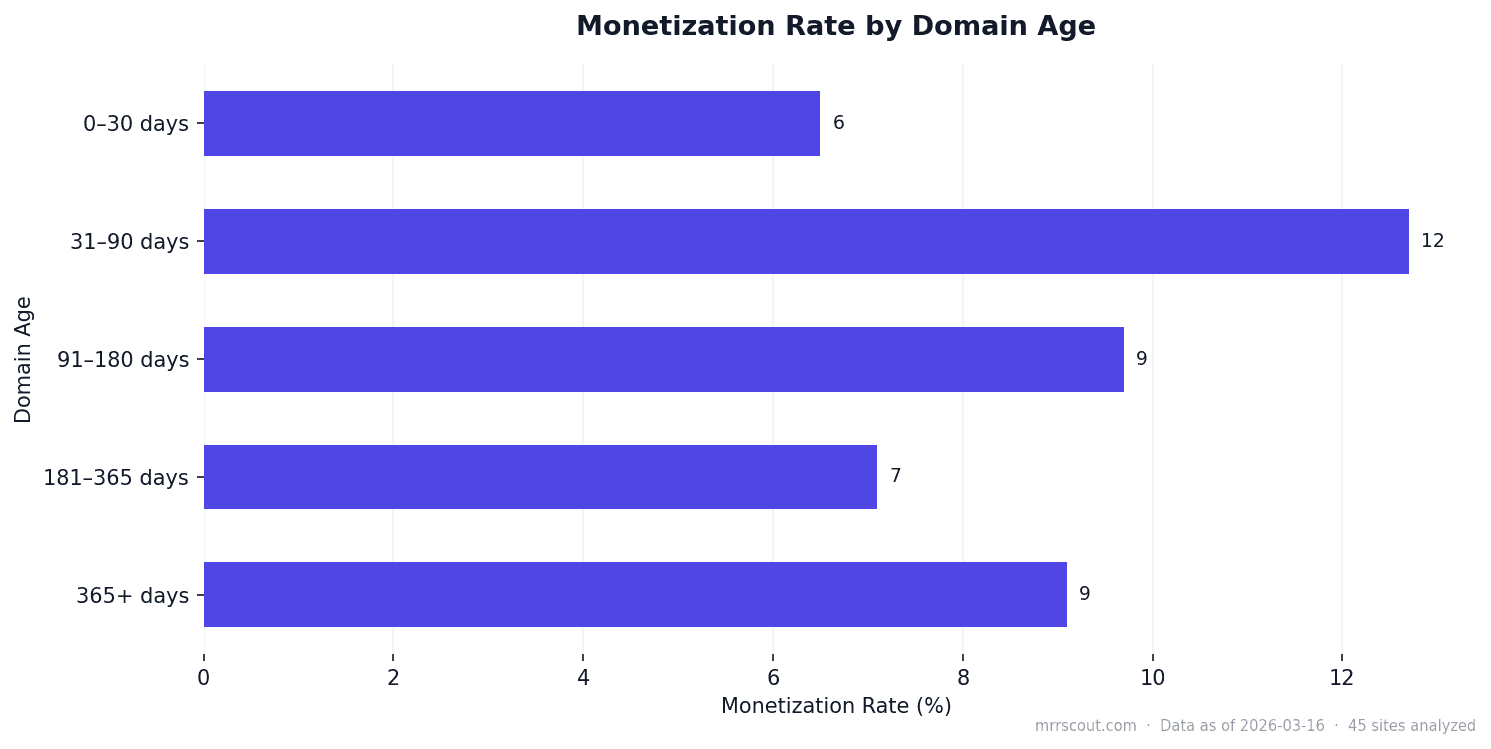
The pattern is unmistakable. Monetization rate climbs sharply in the first 90 days, then falls back — before partially recovering in the 365+ cohort, likely from survivor bias (weak sites quietly disappear, leaving the monetized ones behind).
Data as of 2026-03-16, 33,677 active sites tracked.
Why Does the 31–90 Day Window Outperform?
We expected newer sites to have lower monetization rates — too early to convert — and older sites to be highest, having had more time to iterate on pricing. What we found instead was a distinct peak window that neither the newest nor the oldest cohort can match.
A few explanations hold up when we look at the underlying data:
The 0–30 day cohort is mostly in setup mode. At 6.5%, these are live domains but often without a functioning product yet. Many are parked, in beta, or waiting on payment infrastructure. The low rate reflects infrastructure lag, not intent.
31–90 days is the "just shipped" sweet spot. This is when founders who actually monetize their products are putting up pricing pages. Our platform detects active payment infrastructure — Stripe, Lemon Squeezy, Paddle integrations — not just aspirational pricing copy. Sites in this bucket have cleared the minimum viable threshold: they exist, they're working, and someone decided to charge for them.
Beyond 90 days, the rate drops. This is the hardest number to explain away. Sites aged 91–180 days have a 9.7% rate, and 181–365 days drops further to 7.1%. One interpretation: projects that haven't monetized by the 3-month mark often enter a slow wind-down. The founders move on, the domain stays live, and the denominator grows while the numerator stalls.
Real Sites in the Window
Our monitoring platform surfaced several strong examples currently sitting inside the 31–90 day peak:
getgeni.us(AI Tools, 38 days at time of detection) — under six weeks live, already showing active payment gateway signalsworldmonitor.app(Developer Tools, 65 days) — a B2B monitoring tool that hit payment infrastructure by the two-month markcookd.ca(Productivity, 85 days) — still inside the window, with confirmed monetization signals active
These aren't cherry-picked outliers. In our 31–90 day cohort of 3,086 sites, 391 show confirmed monetization — that's the 12.7% figure, across all categories.
What This Means for Competitive Monitoring
This pattern is actionable for anyone building or tracking SaaS. If you're watching a niche, the 31–90 day window is when your most serious competition announces itself. A new entrant that reaches payment infrastructure within three months is signaling real intent — not just a side project.
Conversely, if you're building: the data suggests front-loading your monetization effort matters. Sites that don't add payment infrastructure in the first 90 days show lower rates even at 6–12 months. Whether that's cause or correlation, the safer bet is to ship pricing early.
The Survivor Bias Caveat
We should be direct about a data limitation here. The 365+ cohort's recovery to 9.1% is almost certainly inflated by survivor bias — sites that launched a year ago and failed quietly exit our tracked universe, leaving a higher-monetization remainder. The 31–90 day peak is less contaminated by this effect because we're capturing a current cross-section of recently registered domains, not a survivor pool.
This doesn't invalidate the finding, but it does mean the 31–90 day outperformance is probably even more pronounced in practice than the raw numbers show — the older cohorts are flattering themselves by comparison.
Frequently Asked Questions
When do most micro-SaaS sites start monetizing?
Based on our platform data, the highest concentration of monetization happens in the 31–90 day window after domain registration, with a 12.7% rate — more than double the rate seen in the first 30 days (6.5%).
What domain age has the highest SaaS monetization rate?
Sites aged 31–90 days show the highest monetization rate in our dataset at 12.7%, peaking well above both new launches and sites that have been live for over a year.
Does an older SaaS site always monetize better?
No. Our data shows monetization rate actually declines after the 90-day mark, falling to 7.1% for sites aged 181–365 days. Older isn't always better — the 31–90 day window is the clearest peak.
How does MRRScout define "monetized"?
A site is classified as monetized only when our platform detects active payment infrastructure — Stripe, Lemon Squeezy, Paddle, Ko-fi, and similar gateways — integrated into the live site. Self-reported MRR or pricing page copy alone does not qualify.
Why might sites lose monetization signals after 90 days?
Projects that don't gain traction often remain live but inactive. The founder moves on, payment integrations may lapse or get removed, and the domain continues counting against the denominator. This dilutes the monetization rate for older cohorts.
What's the best time to launch SaaS pricing?
The data suggests front-loading matters. Sites that reach active payment infrastructure within 31–90 days show the highest monetization rates. Waiting past the 3-month window correlates with lower rates at every subsequent age bucket.
Is this pattern consistent across SaaS categories?
The 31–90 day peak holds across AI Tools, Developer Tools, and Productivity in our dataset. Category-specific variation exists, but the age-based peak window appears to be a platform-wide pattern rather than a niche effect.
Where does MRRScout's data come from?
All statistics in our articles come from MRRScout's intelligence platform, which continuously monitors 24,000+ newly launched websites across Reddit, Product Hunt, Hacker News, BetaList, certificate transparency logs, and domain activity feeds. Sites are classified as monetized only when active payment infrastructure is detected — not based on self-reported MRR or founder claims. Data snapshots are timestamped in each article. Full database: [mrrscout.com/discover](https://mrrscout.com/discover). --- *Tracking which micro-SaaS sites just entered the monetization window? Browse the live feed at [mrrscout.com/discover](https://mrrscout.com/discover).*
Want to discover rising micro-SaaS before the crowd does?
Join the MRRScout waitlist