March 13, 2026
What Makes a Micro SaaS Worth Buying: 5 Acquisition Signals from 24,000+ Sites
Sites using SaaS-native payment stacks score 36% higher on acquisition appeal. We analyzed 24,000+ sites to find the signals that separate acquirable micro SaaS from noise.
Buyers don't read your pitch deck first. They look at signals — infrastructure choices, discovery channels, domain age, payment stack. Our intelligence platform monitors 24,000+ newly launched sites, and the patterns that separate high-value acquisition targets from dead weight are surprisingly consistent.
Here are the five signals that matter most, ranked by how strongly they correlate with acquisition appeal in our dataset.
Signal 1: Your Payment Stack Is a Valuation Shortcut
The single strongest infrastructure signal we track is payment gateway type. Sites running SaaS-native payment infrastructure — Stripe, Paddle, or LemonSqueezy — average a NicheScore of 34.3, compared to 27.5 for e-commerce gateway users (Shopify, WooCommerce) and 25.2 for all others.
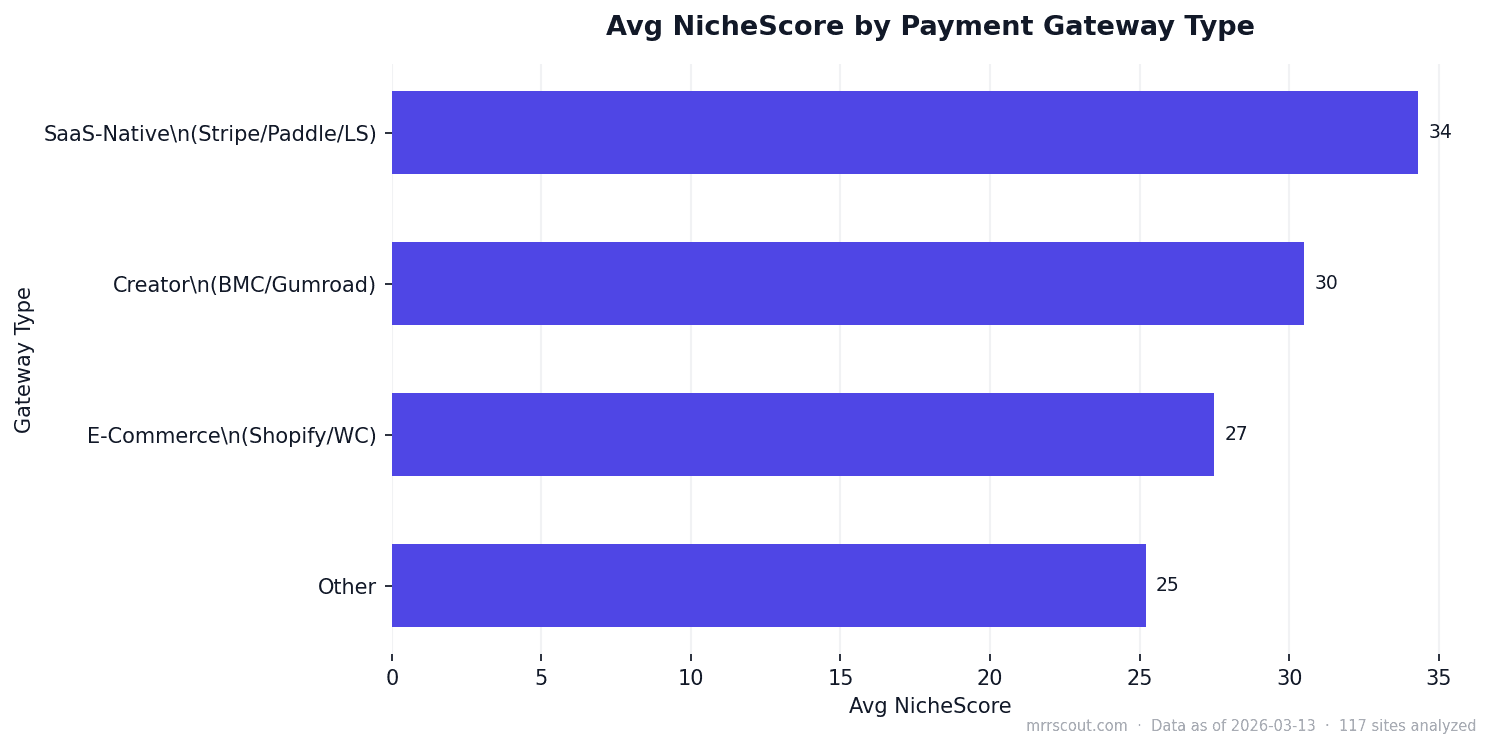
That's a 36% gap between the top and bottom tier. More telling: the monetization score for SaaS-native gateway sites averages 90.6 out of 100 — versus 57.3 for e-commerce setups. A smart buyer scanning acquisition targets can filter on payment infrastructure before reading a single line of product copy.
What does this mean for founders? If you're building a subscription tool and routing payments through Shopify or a generic processor, you're inadvertently suppressing your own acquisition signal. The payment stack is a statement of intent.
Signal 2: Where Your Site Was Discovered
We expected ProductHunt to dominate. It didn't.
In our dataset, sites first detected via GitHub surface with an average NicheScore of 46.6 — nearly double ProductHunt's 24.9. Sites from Hacker News average 28.3. BetaList sits at 25.8. Y Combinator-linked sites reach 32.5.
The pattern makes sense in hindsight. GitHub-originated products tend to be developer tools with real technical depth and organic traction before any marketing push. They're found because they're genuinely useful, not because a founder paid for a launch feature. That signal is hard to fake.
Creator-community sites (launched via Toolify, MicroLaunch) average 15–17 — still valuable, but they serve a different buyer profile. If you're optimizing for acqui-hire or technical acquisition, being discoverable via developer-native channels carries measurable weight.
Signal 3: Education and Productivity Beat AI at Monetization
This is the finding that consistently surprises people.
In our monitored universe, Education sites monetize at a 38.4% rate — the highest of any category. Productivity follows at 24.1%. Developer Tools come in at 22.6%. Meanwhile, AI Tools — despite representing the largest single category (31,475 sites) — monetize at just 15.8%.
The NicheScore gap follows the same pattern: Education averages 20.4, Productivity 19.1, while AI Tools trail at 17.2.
The supply-demand dynamic explains this. AI tool density is so high that generic AI wrappers have negligible differentiation. Vertical niches — a specific education workflow, a focused productivity use case — carry defensibility that broad AI tools don't. For buyers seeking durable revenue over speculative upside, the numbers favor specificity over trend-chasing.
Signal 4: Domain Age Compounds Acquisition Value
Domain age correlates with monetization rate more cleanly than most founders expect. Sites with domains registered 3+ years ago monetize at a rate of 10.3% — 25% higher than sites under six months old (8.2%).
This isn't just about SEO authority, though that's a factor. Older domains signal that a product survived the initial enthusiasm phase. A buyer acquiring a 3-year-old domain with active payment infrastructure is buying a different risk profile than an equivalent-looking 6-month product.
The practical implication: if you registered your domain recently but have strong monetization signals, pairing that with a visible public growth timeline (changelog, feature history, public metrics) helps bridge the trust gap that raw domain age creates.
Signal 5: Pricing Page + Payment Infrastructure Is the Full Stack
Only 2.6% of active sites in our dataset carry both a pricing page and detected payment infrastructure. That's roughly 846 sites out of 32,000+. Just 0.9% have a pricing page without active payment detection.
This scarcity matters. A site with both signals visible is immediately identifiable as a conversion-optimized product — not a hobby project, not a demo, not an experiment. For buyers running systematic acquisition searches, this combination functions as a first-pass filter that eliminates most of the noise instantly.
Sites with only one signal (pricing page without payment, or payment without structured pricing) still score better than neither — but the combination is where acquisition conversations tend to start.
Three Real Sites Our Platform Is Watching
We don't name targets to drive traffic to them. We do use them to illustrate the signal patterns.
attentionworth.com (Productivity, launched February 2026): NicheScore 53.2, detected with Productivity classification and multiple monetization signals within weeks of launch. A rare case of a sub-year-old domain hitting mid-50s territory.
buyvsrent.org (Finance, launched February 2026): NicheScore 47.8, Finance category with pricing page and active payment detection. Finance vertical tools surface infrequently in our monitored channels — this one stood out.
apipick.com (Developer Tools, launched May 2025): NicheScore 39, developer-tool classification with dual payment gateway setup and structured pricing. Clean acquisition profile for a domain under one year old.
All three represent the pattern: vertical focus, SaaS-native payment infrastructure, structured pricing, discovered through developer- or community-native channels.
A Note on What Our Platform Can't Tell You
Signal detection is not valuation. Our system identifies infrastructure, discovery source, domain characteristics, and monetization indicators. It cannot measure customer satisfaction, churn rate, founder dependency, or the real ARR behind a payment gateway detection.
A high NicheScore signals acquisition interest — not acquisition price. The combination of signals we track tends to predict which sites attract serious buyer attention. What happens in due diligence is outside our scope. Treat these signals as a first-pass filter, not a final verdict.
Frequently Asked Questions
What is a NicheScore and how is it calculated?
NicheScore is MRRScout's composite signal score combining monetization detection, social traction, growth signals, freshness, and replicability. Higher scores indicate stronger acquisition appeal based on observable platform signals — not founder-reported metrics.
Which payment gateways signal the highest acquisition value?
In our dataset, Stripe, Paddle, and LemonSqueezy-using sites average a NicheScore of 34.3 — 36% higher than sites using other payment infrastructure. These gateways indicate recurring subscription intent rather than one-time transaction focus.
Does AI niche still have acquisition value in 2026?
Yes, but selectively. Broad AI tools monetize at 15.8% in our dataset — well below Education (38.4%) and Productivity (24.1%). Vertical AI applications targeting specific workflows show significantly better monetization signals than general-purpose AI wrappers.
How does domain age affect acquisition attractiveness?
Sites with 3+ year-old domains monetize at 10.3% versus 8.2% for sites under 6 months — a 25% gap. Older domains signal product survival and reduce buyer risk perception, particularly for bootstrapped products without public revenue metrics.
What's the difference between "has pricing page" and "has monetization" signals?
Our platform detects pricing pages (structured plan/pricing UI) separately from active payment infrastructure (live payment gateway integration). Only 2.6% of tracked sites carry both signals. Sites with only a pricing page may be pre-monetization; sites with payment but no structured pricing often run closed/enterprise deals.
Can I use MRRScout to find acquisition targets directly?
Yes. The [discover](https://mrrscout.com/discover) view lets you filter by category, monetization signal, and other indicators. Combine filters for payment detection + pricing page + specific categories to surface pre-screened targets.
Where does MRRScout's data come from?
All statistics in our articles come from MRRScout's intelligence platform, which continuously monitors 24,000+ newly launched websites across Reddit, Product Hunt, Hacker News, BetaList, certificate transparency logs, and domain activity feeds. Sites are classified as monetized only when active payment infrastructure is detected — not based on self-reported MRR or founder claims. Data snapshots are timestamped in each article. Full database: [mrrscout.com/discover](https://mrrscout.com/discover).
Want to discover rising micro-SaaS before the crowd does?
Join the MRRScout waitlist