March 12, 2026
Why Education SaaS Has the Highest Monetization Rate in 2026
Education SaaS monetizes at 24.5% — 2.4× higher than AI Tools. Our platform data across 28,000+ sites reveals why this overlooked category outperforms every trendy niche.
Education is not where most indie hackers look. When choosing what to build, founders flock to AI tools, developer utilities, or e-commerce plugins. The data disagrees with that instinct.
In our dataset of 28,634 tracked sites (data as of 2026-03-12), Education SaaS sites monetize at 24.5% — more than double the rate of AI Tools (10.2%), and nearly seven times higher than E-commerce (3.8%). That's not a rounding error. It's a signal worth understanding.
The Numbers Across Every Category
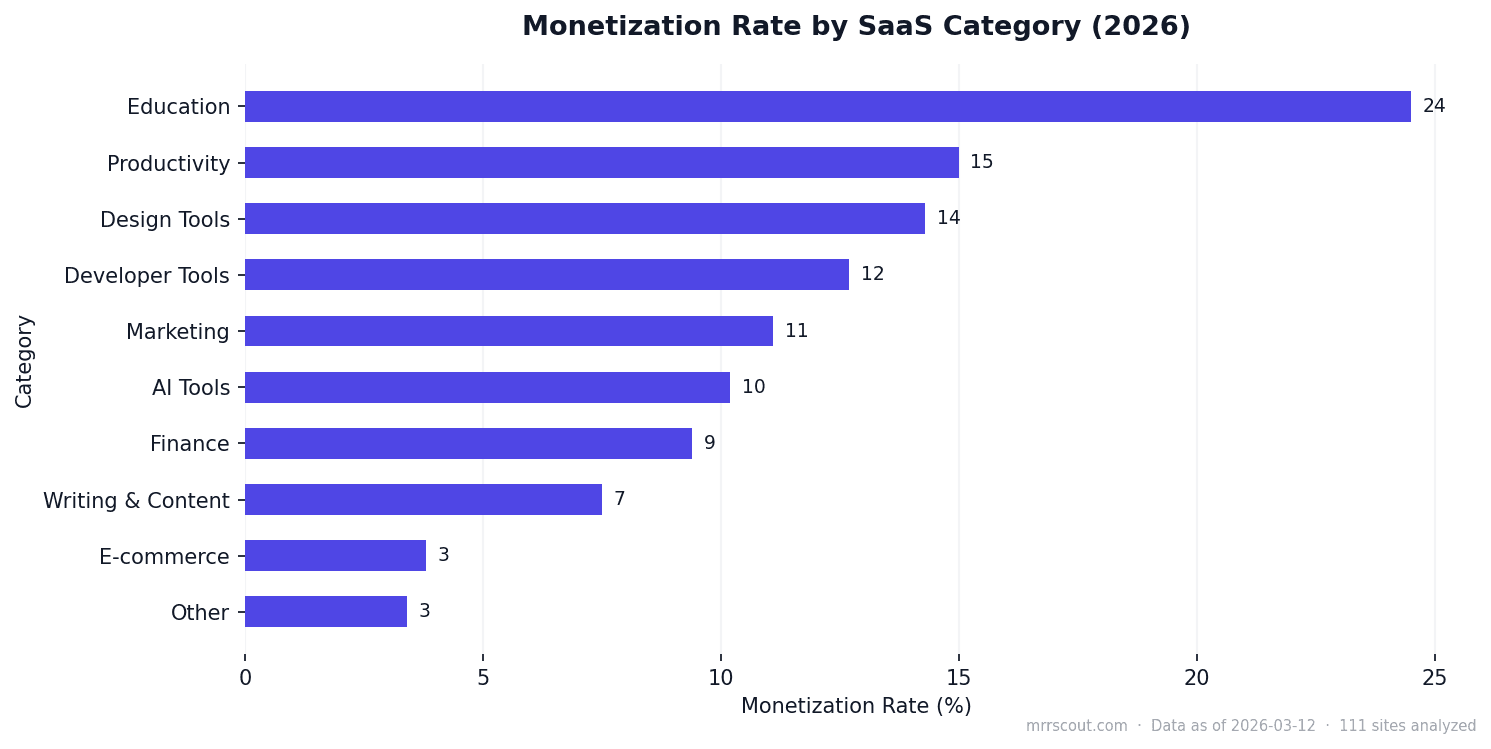
Across all nine tracked categories, the ranking by monetization rate looks like this:
| Category | Sites Tracked | Monetization Rate |
|---|---|---|
| Education | 139 | 24.5% |
| Productivity | 353 | 15.0% |
| Design Tools | 1,287 | 14.3% |
| Developer Tools | 1,066 | 12.7% |
| Marketing | 477 | 11.1% |
| AI Tools | 4,890 | 10.2% |
| Finance | 288 | 9.4% |
| Writing & Content | 467 | 7.5% |
| E-commerce | 3,635 | 3.8% |
In our dataset of 28,634 active sites, Education sits at the top with a 24.5% monetization rate — 2.4× higher than AI Tools and 6.4× higher than E-commerce.
What We Expected vs. What We Found
We expected AI Tools to lead. That's where the investment is, where the launches are, where the Product Hunt upvotes pile up. With nearly 5,000 AI tool sites tracked, it's the single largest category in our database.
What we found instead: AI Tools rank sixth out of nine. Productivity (#2) and Design Tools (#3) both beat it handily. Education, which accounts for fewer than 0.5% of all tracked sites, beats every other category by a wide margin.
The difference isn't about quality or founder skill. It's about demand structure.
Why Education Converts Better
Education buyers have a clear outcome in mind. A teacher who needs an AI grading platform — like markinminutes.com, which launched in December 2025 and immediately activated payment infrastructure — isn't browsing. She has a problem right now: 200 essays, a Friday deadline, and no time.
That specificity translates directly to willingness to pay. Compare that to the average AI tool, which often solves a vague productivity need for someone who could probably muddle through without it.
studybuddy.academy, launched in early March 2026, converts notes into AI-generated slides, flashcards, and quizzes. It had payment infrastructure live within days of launch. The value proposition is crisp: upload a PDF, get exam-ready materials. Students know exactly what they're buying.
This is the pattern we see across Education sites that monetize: tight problem, measurable outcome, buyer who already has a budget line for learning tools.
The AI Tools Trap
The crowding problem is real. In our dataset of 4,890 AI tool sites, only 10.2% have confirmed monetization. That means nearly 4,400 AI tools are live right now — generating traffic, burning hosting costs, collecting emails — without any payment infrastructure detected.
Education, by contrast, has 139 tracked sites and 34 of them are collecting money. The category is small. The conversion rate is high. That's exactly the market structure micro-SaaS builders should be hunting for.
Not Just Education
The same logic extends to the other top performers. Productivity at 15.0% suggests that when someone pays for a productivity tool, they have a specific workflow they're trying to fix. Design Tools at 14.3% reflects a professional buyer — a freelancer or studio — who directly bills clients for design work and therefore has a real cost-of-tools mentality.
These are niche categories. They're not small because the market is bad. They're small because most builders ignore them in favor of whatever's trending.
One Data Limitation Worth Naming
Our monetization detection is infrastructure-based — we look for active payment systems, not self-reported MRR. A site with Stripe configured but zero customers looks the same as a site doing $10,000/month. The 24.5% Education figure tells us how many sites have attempted to monetize, not how many are profitable.
That said, the gap between Education (24.5%) and AI Tools (10.2%) is large enough that it holds even under conservative interpretation. Education founders are twice as likely to have real payment infrastructure — which means they're at minimum twice as likely to have paying customers.
What This Means for Builders
microgaps.com, an education-adjacent site offering Micro SaaS opportunity reports via Lemon Squeezy, launched in February 2026. It targets indie hackers who want to skip research and start building. The domain is educational, the buyer is specific, and the payment system was live at launch.
That's the pattern: serve a specific learner with a measurable outcome, charge accordingly, launch with payment from day one.
If you're choosing a niche and you want the highest odds of building something that collects money, our data points at Education, Productivity, and Design Tools — in that order. The AI Tools wave isn't over, but it's crowded in a way these other categories aren't.
Frequently Asked Questions
Why does Education have such a high monetization rate compared to AI Tools?
Education buyers have specific, measurable outcomes — pass an exam, grade papers faster, learn a skill — and are often spending institutional or professional budgets. AI tool buyers are more diffuse, which makes converting them harder.
Does a higher monetization rate mean more revenue per site?
Not necessarily. It means a higher percentage of sites have active payment infrastructure. Revenue per site depends on pricing, traffic, and conversion — which our platform doesn't directly measure.
Are there specific types of education SaaS that perform best?
From our dataset, the clearest patterns are AI-assisted study tools (flashcards, quiz generators), grading/feedback platforms for teachers, and niche learning tools for professional skills. All share a tight problem-to-outcome structure.
Is the Education category saturated?
At 139 tracked sites, it's one of the smallest categories we monitor. Compare that to 4,890 AI tool sites. On a relative basis, Education remains underpopulated — especially outside the US English market.
How does pricing typically work for Education SaaS?
Based on sites in our dataset, the most common models are subscription (monthly or annual access), one-time purchase for templates or course materials, and credit-based usage for AI features. Freemium with a paywall on advanced features also appears frequently.
Should I build in Education if I have no background in it?
Domain knowledge helps but isn't required. Several monetized education sites in our dataset were clearly built by developers who identified a specific teacher or student pain point. The key is narrowness — solving one specific learning problem well beats building a generic learning platform.
Does this data apply globally or just to English-language SaaS?
Our platform primarily surfaces English-language sites through Reddit, Product Hunt, Hacker News, BetaList, and similar sources. The monetization patterns likely hold broadly, but specific rates may differ in non-English markets.
Where does MRRScout's data come from?
All statistics in our articles come from MRRScout's intelligence platform, which continuously monitors 24,000+ newly launched websites across Reddit, Product Hunt, Hacker News, BetaList, certificate transparency logs, and domain activity feeds. Sites are classified as monetized only when active payment infrastructure is detected — not based on self-reported MRR or founder claims. Data snapshots are timestamped in each article. Full database: [mrrscout.com/discover](https://mrrscout.com/discover).
Want to discover rising micro-SaaS before the crowd does?
Join the MRRScout waitlist