March 15, 2026
Why Design Tools Outmonetize AI Tools — And What Hacker News Gets Wrong
Design Tools monetize at 15.7% vs AI Tools' 11.4% — despite 3.7× fewer sites. Our data across 38,000+ sites reveals why category choice matters more than hype.
Everyone building in 2026 is building AI tools. Browse any indie hacker forum, scroll Hacker News, or check the latest Product Hunt launches — AI wrappers, AI copilots, AI "everything." The assumption baked into this frenzy is simple: AI = demand = monetization. Our data says otherwise.
Across 38,000+ newly launched sites tracked by our intelligence platform, Design Tools monetize at 15.7% — compared to 11.4% for AI Tools. That's a 38% gap in monetization rate, in favor of the category nobody's hyping.
The Numbers Don't Lie (But They Surprise)
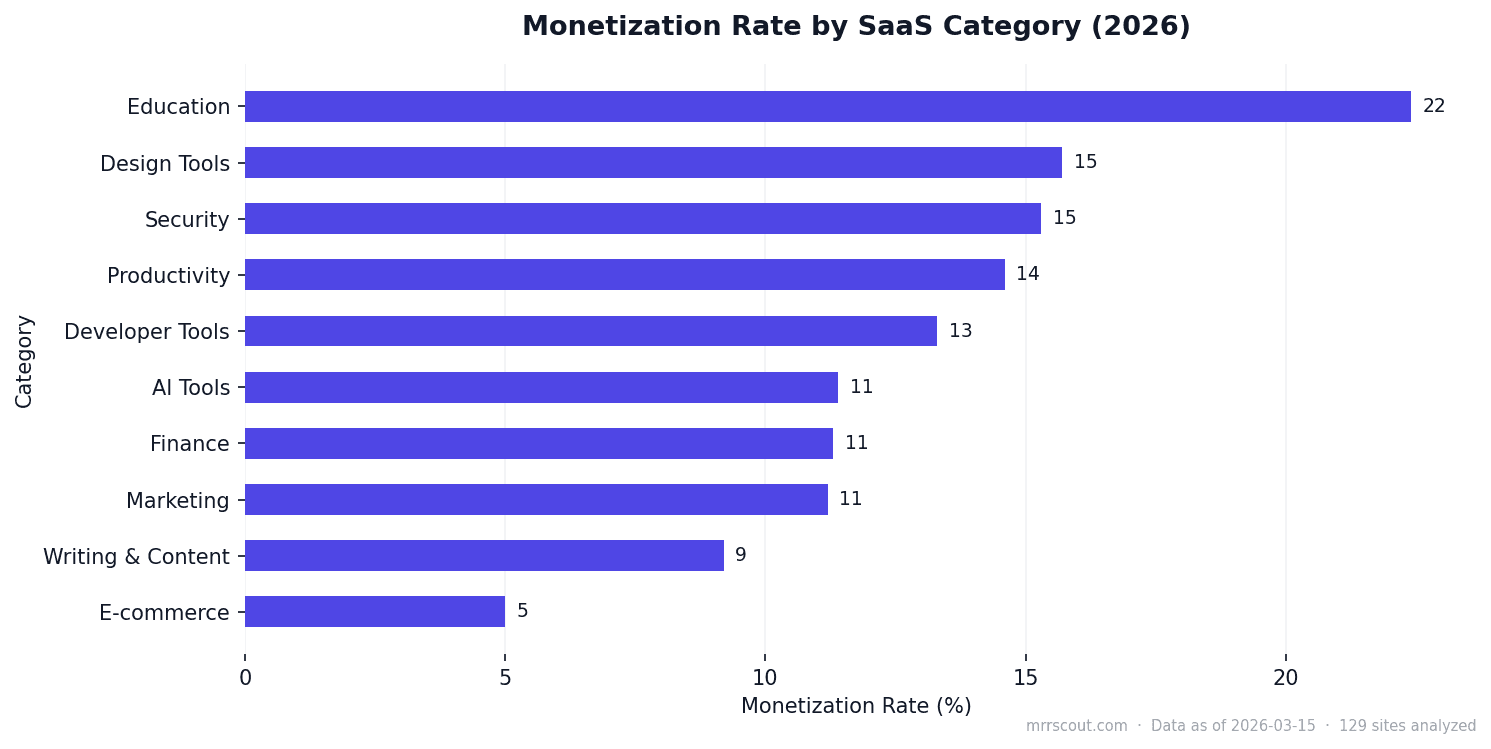
In our dataset of 38,000+ sites tracked as of March 2026, Design Tools is the second-highest monetizing category after Education (22.4%). AI Tools, despite representing nearly 6,800 sites — the largest non-"Other" segment — sits at 11.4%.
Put differently: there are 3.7× more AI Tools sites than Design Tools sites, but Design Tools convert at a meaningfully higher rate. Less noise, more signal.
What about the other categories? Security (15.3%) and Productivity (14.6%) also outperform AI Tools. Finance and Marketing both land around 11% — roughly the same as AI Tools, with far less competition.
The implication is uncomfortable but worth sitting with: chasing the hot category doesn't improve your odds of monetizing.
The Pricing Page Signal: Where Design Tools Really Pull Ahead
Here's the finding that surprised us most. When we look only at sites that have a dedicated pricing page — a strong signal of monetization intent — the conversion rates diverge sharply.
Among Design Tools sites with a pricing page, 88.7% end up monetizing. For AI Tools, that figure drops to 76.1%.
In our dataset of 1,806 Design Tools sites, 141 have a pricing page. Of those, 125 successfully monetize. That's an extraordinary hit rate. The pattern holds across Education (83.3%) and E-commerce (86.4%) too — categories with clear, tangible value propositions where buyers can answer "what am I paying for?" in one sentence.
AI Tools, by contrast, often struggle with that question. A lot of AI wrappers are solving problems users don't yet know they have — or solving them in ways that feel replaceable.
What Hacker News Gets Wrong
We expected HN-discovered sites to outperform the baseline. Hacker News is full of technical founders, sophisticated readers, and people who appreciate well-crafted products. Surely that audience signals quality.
What we found instead: sites first detected through Hacker News's "What are you working on?" threads monetize at just 1.9% — for both AI Tools and Design Tools. That's compared to 11.4% and 15.7% for the same categories overall.
Why? A few possible explanations. HN showcases work-in-progress projects, many of which never reach full launch. The demographic skews toward engineers who share freely but commit money slowly. And the feedback culture rewards technical novelty over commercial sharpness.
The lesson isn't to avoid HN — it's valuable for visibility and early feedback. But don't mistake HN traction for monetization signal. Our data shows it's essentially uncorrelated.
Real Examples From Our Platform
Some Design Tools we've tracked that moved quickly to monetization:
- seojuice.io — An SEO visibility tool covering Google, ChatGPT, and Claude. Uses Paddle for billing, clearly positioned for marketers willing to pay for rankings.
- truepalette.io — A seasonal color palette analyzer. Niche, specific, and easy to understand. The value prop fits in a headline.
- roadmapsnapweb.pages.dev — Turns complex program roadmaps into visual snapshots. Detected by our platform and payment infrastructure confirmed within days of launch.
These aren't unicorns. They're tools solving narrow, concrete problems — where "what does this do and why should I pay?" has a one-sentence answer.
Why Design Tools Have a Structural Advantage
Design is visual. Output is immediate. A user uploads something, sees a result, and can judge the value in seconds. That "aha" moment compresses the sales cycle dramatically.
Compare this to many AI Tools, where value often depends on sustained use, workflow integration, or prompt engineering skill. The user has to invest before they can evaluate. That friction kills conversions — even for genuinely good products.
There's also a pricing psychology factor. Design tools traditionally have clear tiers (free to export watermark-free, pro for team features, etc.). The freemium-to-paid path is well-established. AI Tools often struggle to find their pricing model, cycling between per-seat, usage-based, and token pricing.
One caveat worth acknowledging: our monetization detection is based on active payment infrastructure signals — Stripe, Paddle, LemonSqueezy, etc. Sites that monetize through enterprise contracts, direct invoicing, or ad revenue may be undercounted. The patterns we describe are real but not exhaustive.
What This Means If You're Choosing a Niche
The data doesn't say "don't build AI tools." It says: category alone doesn't make monetization easy. If you're building an AI tool that solves a visual, concrete, immediately-demonstrable problem — you're effectively building a Design Tool with AI inside.
The monetization-predictive factor isn't the technology stack. It's whether a stranger can understand the value in 10 seconds and see a clear reason to pay.
Education (22.4% monetization rate) leads the board, and the reason is similar: tutors, courses, and skill tools have established, normalized payment patterns. People are already used to paying for learning.
If you're early in choosing a direction, look at the intersection: education or design problems, solved with modern tooling. The data suggests that's where monetization comes most naturally.
Data as of March 2026, 38,000+ sites tracked across our monitoring platform.
Frequently Asked Questions
Why do Design Tools monetize better than AI Tools?
Design Tools solve visually immediate, easy-to-evaluate problems. Users can see the value in seconds, which compresses the decision to pay. AI Tools often require sustained use before value is clear, increasing friction.
What counts as "monetized" in your data?
We classify a site as monetized only when we detect active payment infrastructure — such as Stripe, Paddle, or LemonSqueezy integrations. Self-reported MRR or founder claims are not used.
Does having a pricing page guarantee monetization?
Not automatically, but it's a strong predictor. Design Tools with a pricing page converted at 88.7% in our dataset — one of the highest rates across all categories.
Why do Hacker News-discovered sites have such low monetization rates?
HN's "What are you working on?" threads surface very early-stage projects, many of which never reach full commercial launch. The audience also skews toward engineers who are slower to convert to paying customers. HN is valuable for feedback, not as a monetization signal.
Is AI Tools really a bad category to build in?
Not inherently. AI Tools that deliver visual, immediate, and easily-understood value tend to monetize well regardless of the "AI" label. The category average is dragged down by many experimental or wrapper-style projects.
What's the best category to build a Micro-SaaS in, by monetization rate?
Education leads at 22.4%, followed by Design Tools at 15.7% and Security at 15.3%. These categories have clear value propositions and established buyer intent.
Which payment processor is most common among Design Tools?
Stripe and Paddle are both well-represented in our tracked Design Tools. Paddle's VAT-handling features make it popular for tools with European audiences.
Where does MRRScout's data come from?
All statistics in our articles come from MRRScout's intelligence platform, which continuously monitors 24,000+ newly launched websites across Reddit, Product Hunt, Hacker News, BetaList, certificate transparency logs, and domain activity feeds. Sites are classified as monetized only when active payment infrastructure is detected — not based on self-reported MRR or founder claims. Data snapshots are timestamped in each article. Full database: [mrrscout.com/discover](https://mrrscout.com/discover).
Want to discover rising micro-SaaS before the crowd does?
Join the MRRScout waitlist