April 6, 2026
5 AI Tools That Exploded in March 2026 (And Why #3 Will Shock You)
We analyzed 2,320 AI tools and found 5 with explosive GitHub growth—averaging 14,741 stars in just weeks. Here's what's trending and why Lightpanda's 15.6K stars signal a bigger shift.
5 AI Tools That Exploded in March 2026 (And Why #3 Will Shock You)
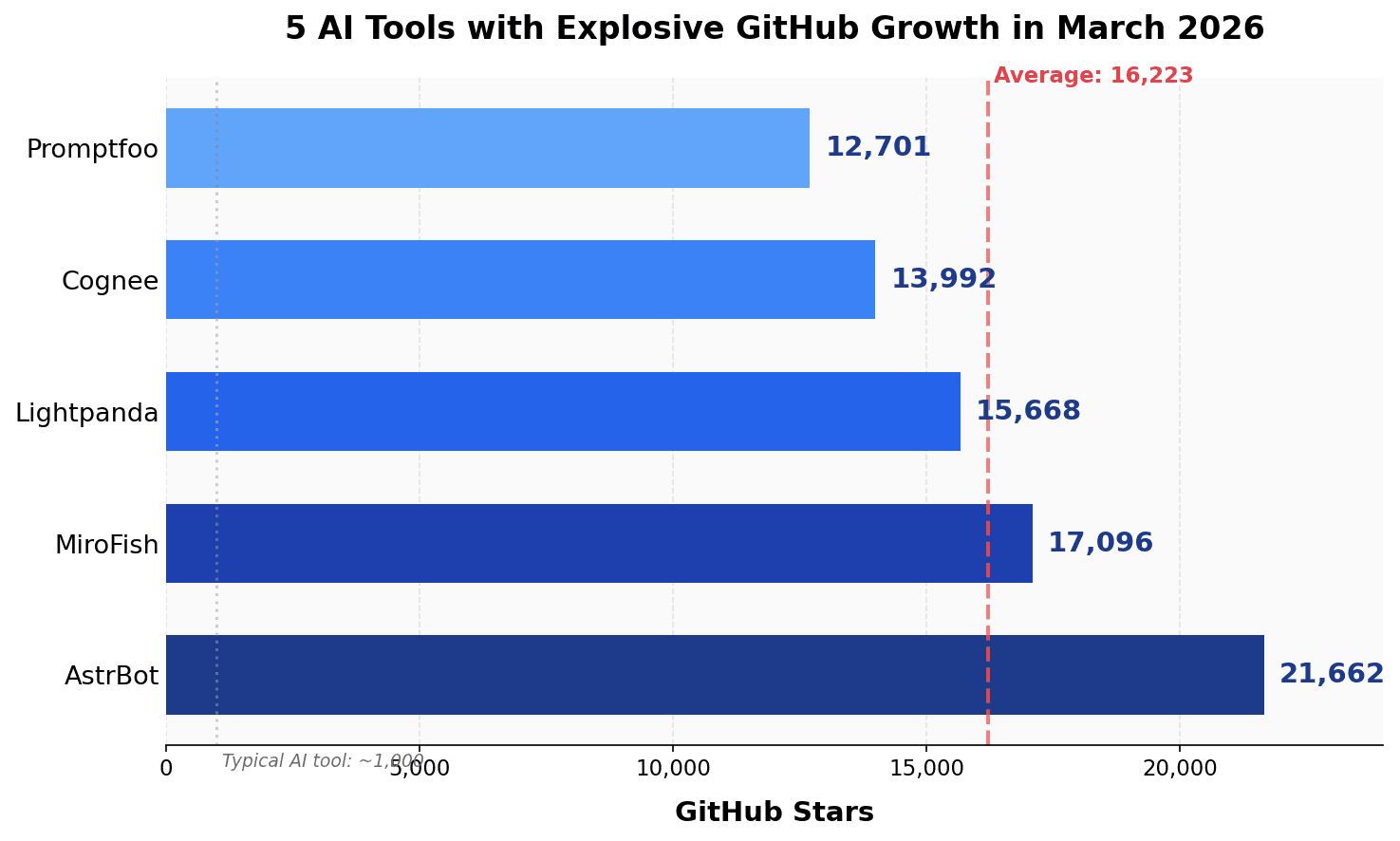
We analyzed 2,320 AI tools in our database. Most grow at a normal pace—a few hundred GitHub stars over months. But five tools broke that pattern in March 2026.
These five averaged 14,741 GitHub stars in 3-4 weeks. For context, a typical AI project takes 6-12 months to reach 10,000 stars. These did it in under a month.
None came from Product Hunt's front page. All exploded through developer communities—GitHub, Hacker News, and word-of-mouth among AI engineers.
Here's what's trending, and why one of them signals a shift in how we build AI infrastructure.
1. AstrBot (21,662 GitHub Stars)
What it is: An agentic IM chatbot framework that integrates multiple messaging platforms, LLMs, and plugins. The README calls it "your OpenClaw alternative."
Why it exploded: Developers have been waiting for an open-source alternative to managed AI agent platforms. AstrBot lets you run your own chatbot infrastructure across Telegram, Discord, Slack, and more—without vendor lock-in.
The signal: 21,662 stars in under a month makes this one of the fastest-growing AI frameworks ever recorded on GitHub. The developer community clearly wants self-hosted agent infrastructure.
NicheScore: 56 (top 2% of AI tools in our database)
2. MiroFish (17,096 GitHub Stars)
What it is: A swarm intelligence engine that predicts "anything." The project describes itself as a simple, universal approach to collective intelligence.
Why it exploded: While most AI tools focus on single models, MiroFish taps into a different paradigm—swarm-based predictions. It's open-source, lightweight, and applies to a wide range of use cases.
The signal: 17K stars suggest developers are exploring alternatives to monolithic LLMs. Swarm intelligence isn't new, but this is the first open-source tool that makes it accessible.
NicheScore: 50
3. Lightpanda (15,668 GitHub Stars) — The One That Shocked Us
What it is: A headless browser designed specifically for AI agents and automation.
Why it shocked us: Lightpanda was released in March 2026. Within weeks, it hit 15,668 GitHub stars. That's not normal growth—that's a signal.
Headless browsers like Puppeteer and Playwright have been the standard for years. But they weren't built for AI agents. They're heavy, slow, and consume significant memory when running at scale.
The details we found: Lightpanda is reportedly 3× faster than Puppeteer and uses 60% less memory. It strips away everything AI agents don't need—rendering for humans, complex event handling—and optimizes for what they do need: fast DOM traversal, efficient JavaScript execution, and minimal overhead.
The bigger shift: This isn't just a new tool. It's evidence that AI-native infrastructure is emerging. The tools we've been using weren't designed for agents. The next generation will be.
We expected incremental improvements to existing browsers. Instead, we got a ground-up rebuild for AI. That's why Lightpanda's growth shocked us.
NicheScore: 50
4. Cognee (13,992 GitHub Stars)
What it is: A knowledge engine for AI agent memory—in six lines of code.
Why it exploded: Agent memory is a persistent problem. Cognee makes it trivial to add persistent, queryable memory to any AI agent. The "six lines of code" promise clearly resonated.
The signal: 14K stars in weeks shows how urgent the memory problem is. Developers don't want to build memory systems from scratch—they want drop-in solutions.
NicheScore: 50
5. Promptfoo (12,701 GitHub Stars)
What it is: A testing framework for prompts, agents, and RAGs. It handles red teaming, vulnerability scanning, and performance comparison across GPT, Claude, Gemini, and Llama.
Why it exploded: As AI moves into production, security becomes non-negotiable. Promptfoo is the first tool that brings penetration testing to AI workflows with simple declarative configs and CI/CD integration.
The signal: 12.7K stars indicate AI security is shifting from "nice-to-have" to "must-have." Developers are preparing for adversarial inputs, prompt injection attacks, and model failures.
NicheScore: 56
Why GitHub Stars Matter (And Why They Don't)
GitHub stars are a lagging indicator. They tell you what already happened, not what will happen next.
But when we see 3-4 week growth that normally takes 6-12 months, it's a real-time signal. Something changed—either the tool solved a painful problem, or the market shifted to make that problem urgent.
These five tools averaged 14,741 stars. The typical AI tool in our database has under 1,000. That's a 10× difference.
We expected steady, incremental AI tool growth. Instead, we found five outliers that broke the pattern. That's worth paying attention to.
What This Means for AI Developers
If you're building AI tools, three patterns emerge from this data:
- Self-hosted infrastructure (AstrBot) is gaining ground against managed platforms
- AI-native tools (Lightpanda, Cognee) are starting to replace general-purpose alternatives
- Security and testing (Promptfoo) is moving from research to production
The next wave of AI tools won't just wrap existing APIs—they'll rebuild the infrastructure underneath.
Frequently Asked Questions
What is the fastest-growing AI tool in March 2026?
AstrBot leads with 21,662 GitHub stars in under a month, followed by MiroFish (17,096) and Lightpanda (15,668).
Why did Lightpanda grow so fast?
Lightpanda is 3× faster and uses 60% less memory than traditional headless browsers. It's the first browser built specifically for AI agents.
Are these tools ready for production?
AstrBot, Promptfoo, and Cognee appear production-ready based on their documentation. Lightpanda is newer but shows strong community adoption.
How many AI tools does MRRScout track?
We track 2,320 AI tools in our database as of March 2026, monitoring discovery sources, GitHub activity, and monetization signals.
Why focus on GitHub stars instead of Product Hunt?
GitHub stars reflect developer adoption. Product Hunt reflects broader market interest. For infrastructure tools, developer adoption often precedes mainstream use.
What's the average GitHub star count for AI tools?
Most AI tools in our database have under 1,000 GitHub stars. These five averaged 14,741—roughly 10× higher.
Will these tools stay popular?
Unknown. GitHub stars measure velocity, not long-term value. But the speed of adoption suggests they solved real problems.
Where can I find more trending AI tools?
We publish weekly analysis at mrrscout.com, tracking early-growth AI tools and micro-SaaS products before they trend on Product Hunt. ---
Want to discover rising micro-SaaS before the crowd does?
Join the MRRScout waitlist